News & Views on Systemic Body Odor and Halitosis such as trimethylaminuria TMAU. If you have fecal odors or bowel odors it may be metabolic/systemic

Showing posts with label fmo3. Show all posts

12 June 2018

FMO3 survey to understand patterns in community

I would suggest its better to do the FMO3 DNA test first rather than the Urine test.
It's important we see a pattern of FMO3 variants to use as proof and to understand.

The FMO3 coding part is a 532 amino acid sequence (3 x 532 nucleotides)

Ways to FMO3 DNA test :
Full sequencing (hard to access)
23andme (23 of the 532 codons)
Geneology dna tests (raw data ... about 25 codons ?)

Ethnicities often have 'haplotypes', certain groups of variants.

Below is an 'ad-hoc' quick FMO3 survey.
The results will be made public.
Intention is to look for patterns.

Link for the survey (e.g. to share) https://tinyurl.com/y7kyxzpc


Problems with DNA testing :
If via a Health system lab, they don't give the 532 data, but rather mention variants they think important. They are likely very conservative.
If via 23andme : You need to look in the raw data. Not too hard. E.g. search FMO3. 

Why FMO3 ?
FMO3 oxidizes 1,000s of substrates, that are sulfides. amines, or phosphate containing.
It is my current opinion that FMO3 weakness is the cause of most cases of 'fecal body odor'.
Most enzymes have only maybe 1 to 10 substrates to alter.
But the oxidizer group, which includes FMO3, have 1,000s of substrates to alter. 


Get new posts by email

25 March 2018

Potential 2 year FMO3 Study

A Metabolic Consultant has offered to do a 2 year study on 2 ways to improve FMO3 function.

Part 2 (part 1 in the paper). would focus on NONSENSE mutations, which are rare but usually severe.
Part 1 would focus on MISSENSE mutations, which will be the vast majority of TMAU1 cases.
Speculation suggests that TMAU2 cases could also possibly be mild missense cases.

I make MISSENSE part 1 as this will be the vast majority
e.g. E158K E308G etc

What's needed for the study to happen :
A TRUSTED PARTY to set up a CROWDFUNDING PAGE.
Youcaring is suggested as it's free and has few clauses : Youcaring
But any crowdfund site would do.

Study cost : about $US 100,000

Why ? 
Someone will be hired fulltime for 2 years.
Plus equipment etc

Study basics :
1. Using ATALUREN to see if it helps with NONSENSE mutations.
2. DRUG REPURPOSING : going through many drugs in FMO3 cells to see if any improve FMO3 function. This would help with MISSENSE mutations.

Drug Repurposing often happens in pharma-world.
Such as viagra originally being for heart disease.
Often multi-uses are found for drugs accidentally.

The study needs funding

A best option would seem to be crowdfunding.
possible scenarios :
A trusted individual or collective to take on the crowdfund.
e.g. A group of respected older women ?
or
Using the REACT Fund as a trusted proxy (if they let the consultant have the money)
RE(ACT) TMAU FUND
or
Any other ideas

Fuller outline of the potential study

 Time-lines for the project (at half-yearly milestones):


Study component
Year 1
Year 2
Generation of a range of FMO3 nonsense and missense mutations and the in vitro tools for their functional analysis in a cell culture system
X
X


Evaluation of the efficacy of read-through agents and other drugs in our in vitro cell culture system, including acquisition of structural and functional evidence


X
X

2.  Repurposing of existing drugs:

TMAU is caused by a functional deficiency of the FMO3 protein.  Many of the missense mutations of the FMO3 gene are hypomorphs, ie there is some residual activity of the enzyme, albeit not enough to prevent the accumulation of TMA.  Augmenting expression of the faulty gene through activation of the FMO3 promoter, could improve overall FMO3 enzyme expression, with significant amelioration of the disorder(19).  Libraries of known therapeutic agents are commercially available that can be used in high throughput screening assays to screen for possible opportunities to “repurpose” the drug, ie apply it in a therapeutic context for which it was not originally designed.

We propose to use the cell culture models developed by us in a high throughput screening approach to identify new potential therapeutic agents that could augment expression of the FMO3 gene.

If we demonstrate potential in vitro efficacy of specific well-established therapeutic agents, we will then potentially be in a position to move to clinical trials in patients with trimethylaminuria, particularly if the therapeutic agent identified has an existing therapeutic track record in other disorders.

1.  Read through of premature termination mutations: (Nonsense mutations)

Premature termination or nonsense mutations arise as a result of a single nucleotide change in a gene where the change leads to the conversion of an amino acid in the protein sequence to a premature stop codon.  Such mutations often result in the protein losing most if not all of its functional capacity.  It was recognised a number of years ago that aminoglycoside antibiotics can force the transcriptional machinery to read through the premature stop mutations, and allow the normal protein to be made, restoring activity of the protein(13).  However, aminoglycoside antibiotics have significant side effects and are not a viable therapeutic option.  More recently a new class of drugs has been developed that has the capacity to promote read through of premature termination mutations, and which appear to be totally non-toxic(14).  One in particular, PTC124, has been shown to result in the production of normal dystrophin in the mdx mouse model of Duchenne muscular dystrophy(14), and has been used in clinical trials in human subjects with cystic fibrosis, with clear benefits being found(15).  In addition, there are a number of other read-through agents currently being evaluated for potential in vitro and in vivo use. An inborn error of metabolism like TMAU would be an excellent candidate for this type of therapy, as an increase of enzyme activity to perhaps as little as 10% of normal should be enough to overcome the biochemical block.


Get new posts by email

14 January 2018

the 'big 3' FMO3 variants : a cheap way to test

There are 3 common variants for FMO3, that perhaps most 'FMO3 smell people' carry. The easiest and cheapest way to find out is to do the 23andme.com test, or an ancestry test that lets you download the raw data.

FMO3 is a 532 amino acid sequence, and 23andme only test about 50 of the 532, but it does test the 3 main variants at codons 158, 257, 308.
It would be interesting to see if most of carry 2 or more of these.

Estimates of carriers of the 3 main variants :
E158K : 40% people ?
E308G : 20% ?
V257M : 10% ?

DIY STUDY
We should be aiming to flood PUBMED with papers about TMAU, SysBO/Hali etc.
PUBMED is where researchers look to see whats going on.

But for now, as beggars, we can try a DIY STUDY.

Question 
Do you carry E158K, V257M and/or E308G ?

Feel free to put your result in the COMMENT SECTION.
Anon if you want ?
e.g.
E158K : AG
V257M : AA
E308G : AG

HOW CAN I TEST FOR THIS ?
A cheap and easy way to test for the 3 most common FMO3 variants is :

1. Find and buy an ancestry test that lets you download the RAW DATA ...
or buy 23andme.com test.

2. Look for these 3 variants :


rs2266782
variant known as E158K
normal : GG
variant : A

rs1736557
variant known as V257M
normal : GG
variant : A

rs2266780
variant known as E308G
normal : AA
variant : G


FMO3 PROTEIN is a 532 amino acid sequence, but there are 3 most common variants. E158K V257M E308G . Many people carry these faults (Whites carry maximum for the 3 : 45%, 25% 10% ...  estimate from memory). No-one is bothered much to find out if they are 'pathogenic' or not, but it would be interesting to see if those who identify with metabolic malodor tend to carry them in a mix.

My own current view :
I suspect most cases of 'metabolic/systemic body odor' are due to weakness in the FMO3 enzyme, but there may be other enzyme disorders too.

COMMENT SECTION
Feel free to put your result in the comment section. Anon if you want.


Get new posts by email

2 January 2018

Wevers & New Halitosis disorder : DMS and CH3SH

A new paper by Drs Wevers, Winkelman, Tanger et al, puts forward the theory that there is a newly discovered disorder that can cause metabolic/systemic halitosis.

The volatiles that cause the smells : DIMETHYLSULFIDE and METHANETHIOL .
Enzyme at fault : SELENBP1 .

title : Mutations in SELENBP1, encoding a novel human methanethiol oxidase, cause extraoral halitosis
Pubmed Abstract :  link
Full paper : Link

First impressions of this new paper/discovery :

1. IMHO it could be classed as the MOST IMPORTANT METABOLIC BODY ODOR DISCOVERY SINCE THE 'DISCOVERY' OF TMAU IN 1970.
The reason being that the concept of 'metabolic/systemic body odor' has relied on 1 compound (Trimethylamine) to prove the concept and be the 'sole' disorder, so more compounds to the list are welcome.
In a perfect world society would say 'let's now find all the metbo compounds' ... but society is not interested.

2. They feel that the gene to blame is SELENBP1 for this new disorder.
I still suspect FMO3 is to blame, so I will keep an open mind for now.

3. DMS and CH3SH are the compounds to blame for this disorder.
People with 'fecal body odor' (as it's known) complain of smelling of many nasty smells. To me, DMS and CH3SH are far better suspects for causing FBO rather than TMA, and they are probably in my top 5 list of potential FBO smell suspects, so to see them identified is very welcome.
I suspect there may be a few more (probably mostly Volatile Sulfur Compounds, thiols') suspects to add to the list, but I regard these 2 as potentially 'main players'.

My example list of FBO suspects (guesses):
Probably VSCs or Thiols ... e.g.

DMS
Methanethiol
Dimethyldisulfide
H2S
Cysteamine (?)
Way down the list .... TMA

When someone has metabolic BO, the 2 questions are :
1. What compounds are causing the smell ?
2. What enzyme(s) are supposed to neutralize those compounds.

So in this case I think they have identified bigger 'players' of the group of compounds that cause FBO, but wrong enzyme (could be wrong).


The 'urine' test for the new 'metbo disorder' : High Dimethylsulfoxide.
For the urine test they go for DMSO level.
Perhaps DMS and CH3SH are too volatile to rely on in a urine test, and may already have dissipated or altered. They seem to go for the OXIDE of DMS, which is perhaps the natural end product, and judge it on higher levels.
I would suggest this is definitely a test we should take.

About Wevers, Tangerman, Winkel et al :
The paper included the 3 above Drs, as well as many others. They have known to have a long interest in the causes of Halitosis, including metabolic causes.
That said, this paper may have taken 10 years (or more) to publish, so my 2 thoughts on their research are :
1. Whilst I welcome it, I am not relying on any breakthrough in society and Drs knowledge of met BO/hali in the near future.
2. I'm hoping perhaps they have 'stored' research and will announce treatments, test options, as a quickfire bundle of announcements this year, but I'm doubtful.

So in conclusion, my current view is :
Potentially 'top of the list' compounds identified to cause metbo body odor.
For now, I'm still a 'FMO3ist' rather than thinking it is SELENBP1.

Them :
compounds : DMS and CH3SH.
enzyme : SELENBP1

Me :
compounds : DMS and CH3SH (and a few more VSCs, thiols etc).
enzyme : FMO3   

Other potential metbo disorders :
I write mostly about my opinion as to the cause of FBO, which seems the main complaint.
I am sure there will be other metbo disorders, but these will be limited to perhaps 1 compound (or a small family), and to other genes.
FBO seems a wide spectrum of smells, so IMHO is most likely a 'broad spectrum' gene, whereas other metbo genes will have a  one distinctive smell (probably), such as isovaleric acid.   

What compounds make feces smell ?
Everyone knows the smell of poo can vary, so for the most part it seems that the compounds that make the smells are varying too. A guess would be they are mostly VSCs / Thiols, and a few other compound families thrown in. But for the most part they would seem to be sulfur compounds.
It may be a surprise to know the World Scientists do not yet have a definitive list of the compounds that make poo smell. Occasionally a researcher (such as Levitt et al) will do a few papers, but many might disagree with them.   

Media links to the story
Gizmodo
Medical Xpress
Science Daily
Genengnews
UCLA press release

Dr Wevers webpage


Get new posts by email

3 September 2017

Mice on high choline diet deficient in choline : Paper

This could be a very important paper for the following malodor problems :
TMAU (if you believe that TMA is the sole source of your malodor).
Possibly 'FMO3 malodors' (if you think many FMO3 substrates cause your smells).
Possibly (in theory), if low blood choline caused smells (this is an unknown).

2017 Paper :
Metabolic, Epigenetic, and Transgenerational Effects of Gut Bacterial Choline Consumption
Romano KA et al
Unis of Wisconsin and Harvard

in the news : link


Summary
Choline is an essential nutrient and methyl donor required for epigenetic regulation. Here, we assessed the impact of gut microbial choline metabolism on bacterial fitness and host biology by engineering a microbial community that lacks a single choline-utilizing enzyme. Our results indicate that choline-utilizing bacteria compete with the host for this nutrient, significantly impacting plasma and hepatic levels of methyl-donor metabolites and recapitulating biochemical signatures of choline deficiency. Mice harboring high levels of choline-consuming bacteria showed increased susceptibility to metabolic disease in the context of a high-fat diet. Furthermore, bacterially induced reduction of methyl-donor availability influenced global DNA methylation patterns in both adult mice and their offspring and engendered behavioral alterations. Our results reveal an underappreciated effect of bacterial choline metabolism on host metabolism, epigenetics, and behavior. This work suggests that interpersonal differences in microbial metabolism should be considered when determining optimal nutrient intake requirements.
in the news : link

My interp
It seems they wanted to see how mice differed between groups that had 1:abundant bacteria that turn choline into TMA ... and 2: mice that had a cloned enzyme that blocked microbes changing choline into TMA.

The results were
The TMA-microbe rich mice had low choline blood levels even on a normal choline rich diet.
This is because the gut microbes COMPETE with the host for choline (and microbes get first go).
This caused significantly lower METHYL DONOR metabolite levels in blood and liver, as choline is one of our main methyl donors.
The low blood methyl/choline levels in blood seemed to cause behavioral problems (e.g. anxiety).

Choline
Seems to be one of our main METHYL DONORS (in the blood).
Is an important fat decongestant for the liver.
As we can make some, it was regarded a non-essential nutrient, but now it is accepted that we cannot make anywhere near the amount we need, so is in effect an essential nutrient.

Behavior problems
It's interesting they report the 'low choline blood' mice as having behavior issues such as anxiety, as many with TMAU report of anxiety.

My thoughts
I have thought this before, that low choline blood may be an issue for anyone with 'TMAU' who eats a high choline diet, or even worse for someone following a low choline diet.
As said, choline is important for the liver and as a methyl donor.

NAFLD
I do wonder if perhaps those with TMAU are prone to non-alcoholic fatty liver disease. Perhaps in general or in a particular way. Very speculative.
Many Drs feel that most westerners will have some fatty liver say over 40+, due to diet and lifestyle. But perhaps low choline could be an issue.

Appropriate tests :
1. I guess a liver ultrasound to see how the liver is. (mainstream test)
2. Choline blood test. This is not mainstream and seems very hard to find. It should be mainstream but it's not.

What can a TMAU person do to raise choline blood levels ?
It would seem impossible as the choline will be altered to TMA before it is absorbed.
One choline expert suggested phosphatidylcholine was less easy for microbes to alter, and may be worth a try (unlikely ??).
My own view is that testing for choline blood level would be the best option, so we could see if there was a 'syndrome' common to us.

TMAU low choline predicament (my theory)
2 scenarios
1. High  choline diet (normal west diet) > TMA microbes eat the choline before they are absorbed > person has low blood choline.
2. Person goes on low choline diet > even lower in blood choline level.

They cloned an enzyme in the microbes that did not produce TMA
I note they mention they had an enzyme cloned and put into microbes that stopped production of TMA.
My guess is this approach would be an obvious therapy for TMAU.
Something we should certainly investigate.
My opinion : PROBIOTIC THERAPY with CLONED MICROBES that don't carry CHOLINE-TMA enzyme is one of our best hopes.

Could low choline blood levels cause the smells ?
I guess it's possible that LOW CHOLINE BLOOD levels could cause the smells for metabolic/systemic malodors to do with related enzymes (e.g. FMO3) , but for now it must be deemed an outside chance but definitely one worth following up.

My advice for now 
Try and find a test supplier to do the choline blood test (possibly very difficult).
And perhaps a liver ultrasound to see if you have some fatty liver.

 Get new posts by email

16 March 2017

Nicotine and common FMO3 variant E308G

New paper looking at what role FMO3 might play in metabolizing nicotine.
Common FMO3 variant E308G seemed to double the time needed to clear n-oxidation metabolites of nicotine.

This paper :
The research is about nicotine metabolism in humans. In this case they looked at common FMO3 variant E308G and it's effect on nicotine metabolites (the n-oxide part) and also in ability to give up smoking.

Paper :
Nicotine dependence is associated with functional variation in FMO3, an enzyme that metabolizes nicotine in the brain. : click link (abstract)

They say :
FMO3 plays a small role in nicotine metabolism.
But an important role, In n-oxidation.
E308G variant reduced n-oxidation of nicotine by 50% (i.e. double the time to clear the n-oxides).
They say FMO3 (and FMO1) is present in the brain.
They suggest the brain connection may have an affect on how likely a person may give up smoking.

CYP2A6 :
CYP2A6 is one of the group of CYP450 oxidizing (redox) enzymes.
Currently it's regarded a heavy-duty player in metabolizing nicotine metabolites in particular.
FMO3 is also a redox enzyme, but currently regarded a small player.

E308G  variant in FMO3 gene :
E308G is at codon 308 of the 532 amino acid FMO3 protein code.
It's meant to be amino acid E but instead is G (or vice versa. can't recall).
Currently it's regarded 'harmless', but many TMAU people carry it.
About 15-25% of whites are thought to carry E308G.
E308G is the 2nd most common FMO3 coding variant in whites after E158K (maybe 10-40% whites).

In this paper they say E308G may double the time needed to clear n-oxide metabolites of nicotine, and also affect the ability to give up smoking ?

FMO3 in the brain :
CYP2A6 is not present in the brain.
But FMO3 (and FMO1) is.

What's this to do with Systemic Body Odor ? :
My own view is that currently FMO3 is the most likely enzyme at fault in systemic body odor cases.  
This paper in relation to FMO3 :
The paper is really to do with smoking, how nicotine in cigs are metabolized, and any clues as to how enzymes may play a role in stopping smoking. I guess they will look a bit more at FMO3 now. But it may be to try and block FMO3 so the person has a bad reaction to smoking (like antabuse and alcohol).
It should ,lead to more FMO3 research anyway.
The labs listed are spread over USA. Probably a union for research in smoking.

Final thoughts :
Not directly to do with Systemic Body Odor but any research in FMO3 is welcome, as it is a very neglected enzyme due to not being thought important.
It's interesting that FMO is in the brain. May play a role in psychiatric disorders and drug metabolism.
I'm not expecting much from this research (but might be wrong).
FMO3 flaws may mean they are not very good 'smokers'. (?)
E308G is carried by maybe about 15-25% whites, and all of them don't smell, so it doesn't seem that solely carrying E308G results in someone having 'smell problems'. 

FMO3 gene :
532 amino acid code for the FMO3 protein. (exon)
They are talking about the variant at codon 308.
Little known about FMO3, but currently E308G is taught as harmless.

All genes also have a 'junk part' and promoter region etc (introns).
You can have faults in the junk part (introns) that affect the coding. (i.e. perfect 532 code and certain intron faults might still mean sub-par function).


Get new posts by email

1 March 2017

New paper : TMAU might not just be FMO3 disorder

New TMAU paper by Monell et al.
Conclusion (?) : TMAU might not just be because of FMO3 enzyme.
Paper funded by NORD grant crowdfunded by TMAU community in 2011.

Around 2009-2011 a TMAU community group spearheaded a crowdfunding campaign to get the NORD TMAU grant past it's $25K trigger point so that researchers could put forward proposals for the grant. The grant was awarded in 2011 to a Monell Chemical Senses proposal. This month the paper has been published in a peer journal.

NORD grant TMAU paper : Genetic analysis of impaired trimethylamine metabolism using whole exome sequencing

Conclusions
Thus, variants in genes other than FMO3 may cause TMAU and the genetic variants identified here serve as a starting point for future studies of impaired TMA metabolism.

My interp of the paper 

My interp is they are saying genetic TMAU may not just be just to FMO3 enzyme flaws. In particualr they mention PYROXD2 enzyme, which has been mentioned in TMAU circles before (can't recall why).  

My own view on the paper (bad analogy ... suspects and safehouses)
If you think of 'volatiles' as the suspects, and FMO3 as the safe-house, they are saying the suspect (TMA) stays at various safehouses, TMA is to blame for all the smells, and only TMA should be followed about even when it leaves FMO3 'house' to other safehouses.

My own current view is the only safehouse to watch is FMO3, and note all the 'volatiles' that stay there. In fact I reckon TMA is a 'small player' and other FMO3 'safehouse' suspects are more likley to blame for smells. Probably the likes of dimethylsulfide.

So this new paper has went in a direction that doesn't fit with my current thinking, but it is 'new' in that they are suggesting TMA might be metabolized by enzymes other than FMO3 (?).

Paper view
Current Safehouse : FMO3
Suspect : TMA is only suspect.
Paper : TMA might have other safehouses.

My View
Safehouse : FMO3
Suspect : many. TMA a small player
My view : No need to follow TMA. FMO3 is only safehouse that matters, Keep an eye on the all suspects at FMO3 house.

Overall, I think so little research has gone into FMO3 and TMA that we may be at 'chapter 1' of understanding them. As this was a small one-off study, I don't expect much more 'TMAU' research on it. But since TMA has been suggested as having a connection with cardiovascular disease, perhaps TMAU people will be able to read on such research from this aspect in future.

Other comments on the paper :

None of the 10 people seem to report fishy smell. Most report 'sulfury'/fecal smells
My impression is that Monell feel TMA causes a fishy smell, but through influence have broadened this to saying TMA might cause smells more broader than that. Personally I think the smells are not due to TMA, but to other volatiles (e.g. sulfides), and in a way TMA is probably a 'small player' but a good biomarker of FMO3 function (? not even sure about that).    

Only one has FMO3 mutations that would be regarded by clinicians as TMAU1 
In academia and the clinical world, the teaching is that genetic TMAU is caused by serious FMO3 mutations. But in this paper only one has taught 'serious' mutations (at codon 148). Or at least, I think faults at 148 are bad. I note that they are not the worst TMAU result in the paper (at about 56%).

All the other FMO3 faults listed are carriers of common 'benign' FMO3 faults

Common FMO3 variants carried by whites by %  :
codon 158 : 20-50% ?
codon 308 -  up to 20% ?
codon 257 -  up to 15% ?

As can be seen, many people carry common FMO3 variants. Currently they are taught as being 'benign'. But in the paper, of the 10 tested, many of them only carry one of these FMO3 faults (mainly 158). Obviously 50% of whites don't have metabolic smells, so it's still an unknown full picture to understand.

The worst TMAU urine result seemed to only carry a PYROXD2 DNA fault.
In this paper, the worst result was #52 who only carried a fault in PYROXD2 enzyme.

Worst result in paper : #52 ... TMAO% output 13% ... FMO3 faults : none ... PYROXD2 faults : carries one

The worst TMAU result had no FMO3 faults and only carried 1 PYROXD2 fault. This throws up more questions than answers. 5 carried PYROXD2 faults (3 were homozygous, 2 heterozygous).

PYROXD2 faults listed : Not in coding part of PYROXD2
To make a PYROXD2 protein, you need an amino acid code. These are the codons on the exons.
Genes also have introns, which are generally regarded as 'junk' or unknown.
In this paper, the PYROXD2 faults listed are in the intronic region (not the exons). So they are not even in the coding part of the enzyme gene.

example of how gene makes a protein.
FMO3 has 532 amino acid code to make the FMO3 protein
this means 532 codons.
Genes also have intron part.
Introns not needed to form the protein, but faults there seem to be able to disable the protein.

PYROXD2 
This enzyme has been listed before in one TMAU paper. I can't recall at the moment.

Final thoughts 
The paper is certainly interesting in that it raises questions about current TMAU  teaching. How much impact it will have ... possibly not much due to lack on interest in TMAU.

I will be looking around at PYROXD2 again in a mild way. My mind is currently too set on FMO3 and all it's sulfide/amine volatiles, rather than TMA.

I have no expertise and my interp and thoughts could be wildly wrong.
My impression is Monell can be sensitive about opinions.

My own current theory on systemic body odor/halitosis
Most people identify with 'fecal body odor'. I think this is due to sulfides, maybe some amines. I think it is due to problems with the FMO3 enzyme. Probably often a combo of FMO3 slight weakness and 'FMO3 substrate gut dysbiosis'.

Get new posts by email

30 December 2016

Putting FMO3 through the 'drug repurpose' checklist

FMO3 has been taught that it cannot be induced as most other redox enzymes can (e.g. the CYPs).
Perhaps this thinking is because so few have investigated FMO3.
A recent paper suggested a Korean herbal mushroom may induce FMO3.

DRUG REPURPOSING :
A (new ?) method of (relatively) 'inexpensive' enzyme research is to check how drugs past their patent period to see if they may be of any use in other health conditions.

Drug Repurposing for enzyme disorders (e.g. FMO3)
For enzyme disorders this probably involves checking the reaction of  the enzyme to a list of unpatented drugs in a lab (e..g FMO3). In this case a priority would probably to be to see if it can INDUCE FMO3 (i.e. make it work harder) so you maybe get another 10-20% output.

Main benefits of Drug Repurposing (?) :
It's RELATIVELY inexpensive.
It should be reasonably quick and easy to do (? a year ?)
A lot will be known of the drugs already.  
May learn more about enzyme (e.g. a group of compounds induce/inhibit)

RESEARCHER INTERESTED IN FMO3 DRUG REPURPOSING
A researcher has shown an interest in putting FMO3 through the 'drug repurposing' check.
As usual funding would be the issue.
A opening estimate is that it may cost around $US 74,000 (probably mostly to hire someone to run the checks.)
An opening estimate is that it would take around a year.
They are looking at possible ways of getting funding but it's difficult.

It's something the community can think about.

Links about Drug Repurposing :
NIH USA website
wikipedia
101 website
findacure UK 

FMO3 and Systemic Malodor
My own interest in FMO3 is because I currently suspect it is my main suspect enzyme for most cases of 'systemic/metabolic malodor' (i.e. caused by an enzyme deficiency or overload, not hygiene etc).
FMO3 oxidizes many sulfides and amines in humans. But other enzymes cannot be ruled out.

Current possible therapies for TMAU or FMO3 'smells' :
TMA inhibition/reduction in the gut (e.g. Cleveleand Clinic working on a reducer to be marketed as a supplement by P&G. Not known when it will be available).
TMA metabolization in the gut (e.g. 'probiotic' that metabolizes TMA. Probably a 'methanogen' which will take it the methane route.)
'Gene Therapy' (probably ideal option)

Get new posts by email

19 December 2016

Can FMO3 be induced by Korean mushroom ?

FMO3 experts teach that (in general ?) FMO3 cannot be induced or inhibited.
This is despite 'redox' enzymes often being induced/inhibited by foods/drugs/compounds.
A good example is a grapefruit compound greatly inhibiting enzyme CYP3A4 (discovered by accident).
FMO3 is known to be inhibited by certain indoles mainly in cruciferous veg (Cashman et al).
Also menstruation hormones have been shown to inhibit FMO3 (Cashman et al).
But still, the teaching seems to be that FMO3 cannot be induced/inhibited.

One view could be that so little is known of FMO3 (and perhaps other redox enzymes, but perhaps FMO3 is less important) that perhaps FMO3 can be induced/inhibited by compounds in food/drink/drugs. We don't know.

Paper : Korean herbal mushroom induces FMO3 
In a research paper last week, the authors seem to think they have shown that FMO3 can be induced by a Asian mushroom commonly used by Korean Herbalists.

Korean paper (University of Seoul, Seoul, Korea):
Korean herbal mushroom induces FMO3 in mice in research paper.
mushroom : Phellinus baumii

Quote :
"PBE was responsible for the induction of Fmo2, Fmo3, and Fmo4 expression. PBE also accelerated the metabolic clearance of carbendazim in vivo and so could be applied to the detoxification of xenobiotics such as drugs, pesticides, and nicotine."

pubmed link to abstract

My own view of this :
It's a one-off paper, perhaps biased to Korean herbal compounds.
I won't be looking to buy the mushroom.
The more I try herbal compounds, the worse I feel.
I think FMO3 was thought to develop in the animal/plant warfare fight, as plants developed poisons, FMO3 was developed to metabolize these (could be wrong),

But, it raises the question again about FMO3 INDUCTION as a possible therapy.

My main thought on this paper :
The notion that FMO3 INDUCTION may be worth exploring as a possible FMO3/TMAU therapy. This would be to say boost function by say 10-20%.
FMO3 induction would probably only be any use to those with FMO3 weakness/deficiency.

Get new posts by email

11 December 2016

AIRE Breath Sensor for FODMAP

Foodsniffer (not the AIRE)
A start-up called FOODMARBLE is launching a breath sensor.
Called the AIRE Breath Sensor.
It is designed for the FODMAP diet.
Detects : HYDROGEN levels ?
Hydrogen is thought to be the main gas given off during gut fermentation.
Hydrogen is used as the gas tested for 'small intestine bacterial overgrowth'.

Possible interest to those with systemic body odor/halitosis :
The blog current view is that FMO3 enzyme may be the weakness for most type of SYSTEMIC BODY ODOR (SBO).
Many of the gases from gut fermentation are probably FMO3 substrates (e.g. certain sulfides/amines).
Many with 'fecal body odor' feel they have 'gut dysbiosis'.
Something like the AIRE may help them track their 'dysbiosis' via hydrogen level.


Initial thoughts about the AIRE :
It's version 1. With hindsight it may be regarded as not very good.
BUT, people with SBO will for the foreseeable future need 'sensors' (probably breath sensors).
If it worked, it may be of some use to track 'gut dysbiosis'.
The platform (device for phone, bluetooth etc) is ideal for the consumer. A SBO sensor will be probably the same (but detect different gases e.g. dimethylsulfide).
Great price ($99 intro price). At that price it's worth a gamble.
(note : I already bought the 'foodsniffer' and 'mint breathometer' (not arrived after 2 months), so will probably not be buying the AIRE soon).

AIRE Sensor website
Twitter
Daily Mail (dec 16)
Press Release (dec 16)
Business Insider (may 16)

Systemic Body Odor needs a Consumer Sensor :
SBO will need it's own version(s) of a 'sensor'. Once it's known what gases act as biomarkers or to detect all the types of gases that cause SBO. A good 'suspect' would be 'dimethylsulfide'.
Currently such a sensor does not exist for systemic body odor.
Partly as the technology had not reached a decent level yet.
Also it seems sensor makers are only realising there was a consumer market for say 'halitosis' sensors, or hydrogen sensors. More because of start-ups getting in the market via crowdfunding.
with SBO, the person usually cannot smell themselves (my opinion, they are usually transient and the brain ignores it's own circulating smells).

One thing is for sure, SBO will need a sensor that detects SBO gases.
Currently we do not know what these gases are (apart from trimethylamine).
It's likely sulfides like dimethylsulfide will be suspects.

Fecal Body Odor :
Probably it's unknown exactly what gases make fecal smells.
Scientists will have a good idea of suspects, but papers are few and contradictory.
Perhaps for SBO, there may be a wide spectrum of sulfides/amines at any point, but perhaps a handful of 'big players' (e.g. dimethylsulfide) which could then act as 'biomarkers' for a sensor.

Possible 'big players' for Fecal Body Odor (guesses) : 
dimethylsulfide
dimethyldisulfide
methanethiol
cysteamine

FINAL THOUGHTS
The SBO community will need their own 'sensor' as they are 'nose blind' to their own smells.
The tech (and makers will) has not been there for consumer sensors.
But over the last 2 years, both the tech and now we see the will, for consumer sensors is happening.
No sensor maker would currently probably invest in a 'SBO sensor', thinking there is no market.
But other sensors may longterm make the process cheaper.
Many with SBO feel they have 'gut dysbiosis', so a sensor like the AIRE may be worth a gamble.
Keep in mind for AIRE it's version 1 (i.e. early days).  

What SBO needs
1. To find out all (or at least the main) volatiles that cause SBO (exploratory tests).
2. From that info, a diagnostic test.
3. A Sensor(s)
4. A DNA test (probably being superceded by exome/genome tests which are mathing price of single gene tests).
5. Therapies/cures.


Get new posts by email

15 November 2016

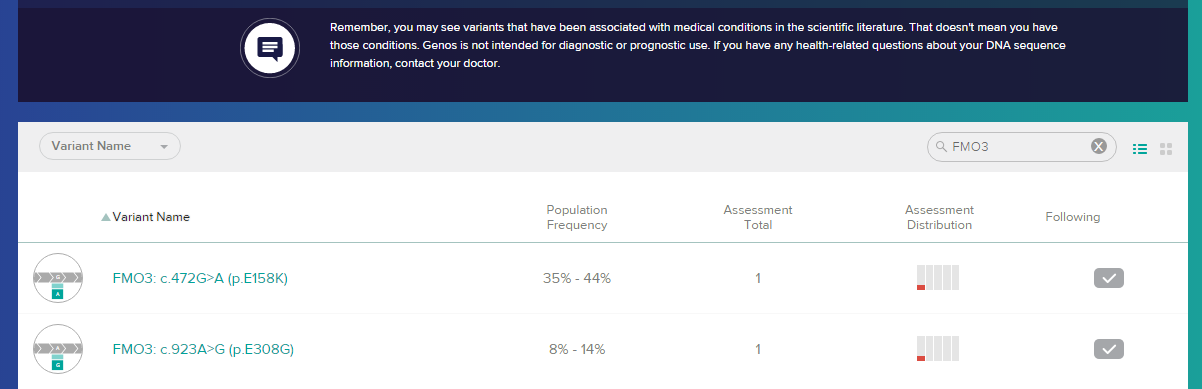
FMO3 gene results with GENOS

I got my Exome test results back from Genos (DNA test).
Cost was $399 (time limited special offer).
Exome is coding part of the Genome (essential part).
For FMO3 the test listed my 2 'wrong amino acid' variants, but not the 'silent' one.
I can't be sure it is FULL SEQUENCING, but rather a 'list of suspects'.
Overall I think it was worth it.
Best overall DNA tester I know (being both for consumer and none of the obstacles of clinical labs).

I got my exome DNA results back from GENOS.
I am very happy with the service, the process, support, and the info given.
My only gripe is I am not sure if it is FULL SEQUENCING (i.e. every codon of a gene).
It possibly is, I don't know yet.

Ways DNA labs test and give results :

1. Test for list of suspect variants/codons only (usually cheapest way).
This is no use really. Still too much unknown of the other bits. This is where they test suspect codons only. This means they choose the list of known suspects, but many more variants may yet to be discovered as fault-causing. You want to know every variant you have, not just suspects.

2. FULL SEQUENCING, but only give SELECTED variants/codons info to the person.
This means they tested every codon but they may only give what they think is relevant info on certain variants. So you still can't be sure you are getting the whole picture.  

3. FULL SEQUENCING and give ALL VARIANTS whether they be thought relevant or not.
This would be as good as FULL SEQUENCING in theory I guess.

4. FULL SEQUENCING (i.e. every codon of the gene)
This is best/good, though I guess in theory you only need to know the variants, so #3 may be more practical. #3 is the same as #4 but without the 'perfect' parts (which presumably won't affect function).

I am hoping Genos is #3, but I have not found out yet. It may be #2 which would not be so good.

EXOME, GENOME :
Exome  = coding for all the proteins in humans
Genome = everything (Exome + Junk + promoter regions etc)

It's thought maybe 80% of faults are in the exome part.
The main reason for EXOME testing rather than GENOME is cost (at the moment).
Exome is obviously the part you can't do without. The essential part.
But people can have faults in the junk part of a gene and it can cause deficiency even though it's junk.
   
MY GENOS DNA RESULT
I have fully sequenced the FMO3 gene before so knew my FMO3 coding part result.
It spotted my 2 carrier copies of the common variants at codon 158 and 308.
These are reasonably common (in caucasians anyway).
There is debate if they affect function (obviously I would say they do).
Some say only if they were from same parent, or if person is homozygous (carry 2 copies).

It didn't spot a silent variant I carry. This is what makes me wonder if they only test a 'suspect list'.
Silent variants are where one of the nucleotides is wrong but the amino acid ends up the same.

FMO3 gene
532 x 3 (1596) nucleotide sequence.
makes up 532 amino acid sequence (+ stop at 533).
makes up the FMO3 protein.
Which means 532 codons where variants can be.

Clinvar list of FMO3 variants

IS IT A GOOD WAY TO DNA TEST FOR FMO3?
Well this is where I don't know (yet).
The best way is to have your full 532 coding sequence, or at least all the variants in that 532 coding sequence (even if they are currently deemed to not matter).
But I don't seem to have the full sequence (not that I can see so far), or all the variants (as they missed a silent one).
The give a raw file but I don't know how to open it.
Answer : I think so but I don't know.

FMO3 DATABASE
In my opinion we should get a FMO3 database going.
But how to, I don't know.
Ideally this would be both the Exon and Intron parts of FMO3 (not just the exons)
Intron is the 'non-coding' part of the gene (which could be junk + promoter region etc).
This would be a pipe dream.

My philosophy on spending on 'systemic malodors'
My philosophy is we don't know what causes it yet, so better to spend money on testing rather than spending on supplements.

FINAL COMMENT
So I can't say for sure GENOS is a great option for DNA testing, but it may be.
And at current price $399 it's cheaper than most FMO3 DNA gene testing .
Plus it's meant for the public and easy to test (saliva).
The question is how much prices will drop quickly and how well competitors do.
In the end you will probably be able to do GENOME testing for maybe $100, but when ?
Also remember, you may find results of other genes you might not want to know (e.g. prone to parkinsons, carrier of cystic fibrosis) so you need to factor in whether you want to know such things.

Note :
I am no expert, so terminology, facts may be wrong.

Links :
Genos DNA TEST LAB FOR CONSUMER


Get new posts by email

23 October 2016

new TMAU review paper by Profs Phillips and Shephard

New TMAU, FMO3 overview paper by Profs Ian Phillips and Elizabeth Shephard (and Fennema).
Probably leading world experts on FMO3 and TMAU.
Overview paper probably contains no new info.
Perhaps Fennema is a student of theirs and did the paper as coursework.
Mentions the TMAO - CVD theory but downplays the connection.

Prof Phillips and Shephard (husband and wife) of London have long been experts in FMO3 and TMAU. They have published many papers on the subject, most probably overviews rather than new research. Fennema is a new name in the TMAU world. Perhaps they are a student of theirs, doing the paper as coursework.


CVD - TMAO theory :
One new issue they write about is the CVD - TMAO theory which was first put forward in 2011 by Hazen et al. My reading of their interpretation is that they are sceptical, and think that TMAO levels may be more a biomarker of general dysbiosis related to obesity, rather than TMAO being the cause of CVD.

Gut flora composition (Bacteroides produce less TMA) :
They also mention that 1 or 2 papers may associate TMA levels with the Firmicute group, and Bacteroide group don't tend to produce TMA as much. At the moment my impression is so little is known of the gut flora that I don't take anything as agreed beyond doubt yet. So it's not something I pay much attention to currently.

Final thoughts :
New TMAU / FMO3 papers are always welcome, and it's a decent overview, but doesn't really add anything new. I'm guessing Fennema is unlikely to publish new TMAU papers if they are a student (except during coursework).

Acronyms :
CVD : cardiovascular disease


Get new posts by email

17 July 2016

FMO3 codon 285 'silent mutation' : N285N

The DNA code for FMO3 is a 1596 nucleotide sequence (532 x 3).
This 532 x 3 nucleotide sequence creates a 532 amino acid sequence which creates the FMO3 protein.

codon 3-nucleotide code resulting amino acid
283 gta valine
284 ttt phenylalinine
285 aac asparagine (N)
286 gat aspartic acid
Silent codons
Often a wrong nucleotide inserted can mean an incorrect amino acid created in the codon sequence.
FMO3 example : the common substitution at codon 158 results in E158K. It should be an E but came out a K (E stands for glutamic acid, K for lysine). Many people have this common mutation (estimates : 20-40% caucasians). It is currently regarded as 'benign' on it's own, but this may in future turn out to be wrong.

However, there are also substitution mutations where the wrong nucleotide is inserted but the resulting amino acid is correct. They are known as 'silent' (presumably as they are presumed not to affect function).
FMO3 example : N285N  (N = asparagine)
N285N turns out to be a seemingly common 'silent mutation' in ethnicities.
The question is, can 'silent' mutations affect function ?
At the moment, who knows ? . We have to assume mainstream experts will currently say no (?)

Common 'silent mutations' in the FMO3 gene coding region:
codon 147
codon 285 (N285N)

My own FMO3 'coding faults'
You can have faults in the coding part of your FMO3 DNA, but also faults in the non-coding parts (introns, promoter region, exon parts that do not code).
Ignoring my non-coding parts (as I don't have the info), I know the most important part : my own 532 coding sequence.
Note : Your 'coding region' can be 'normal' but you can still have TMAU due to faults in the non-coding region.

I carry 3 common SNP's :
E158K
N285N
E308G

FMO3 is about efficiency :
Bad analogy : 100m runner. Say a runner has small handicaps, e.g. broken arm. This may not effect his run much (say 94% normal). Whereas a broken leg may make the run 20% normal. It's the same idea with most FMO3 faults. They may affect function minimally, or you may have a few compounded small gene faults which may drag you down to 85% sometimes. FMO3 should be working at say 95%+.

So at the moment I am presuming my 'small faults' combine to affect FMO3 function either to a small % or perhaps intermittently. Personally I always feel lousy (e.g. migraine) and suspect it may be to do with FMO3 function as FMO3 is regarded as one of the group of heavy-duty 'detoxifier' enzymes (in the case of FMO3, to detoxify abundant small sulfides and amines of a certain structure). It seems not that much is known of the 'detoxifier enzymes', with the main group (the CYP450's) being identified as the main players, and FMO3 regarded as lesser players ... but perhaps this will later prove to be incorrect,

The main reason for the post was to point out the notion of 'silent' SNP's.

Commonality of N285N :
This paper from 2006 mentions N285N and it's commonality in some ethnicities.
2007 FMO3 paper :
Identification and Functional Analysis of Common Human Flavin-Containing Monooxygenase 3 Genetic Variants

Summary :
N285N silent mutation is currently regarded as having no effect on the efficiency of FMO3 enzyme function, and is quite common. It will most likely not be listed in a clinical FMO3 gene test as they tend to list only mutations they feel may have an affect. To see if you have N285N, you would need a copy of your full 532 codon FMO3 code (or at least, any variations from 'normal' listed).

What has this to do with systemic body odor ?
My own current belief is that FMO3 enzyme may be implicated in most cases of systemic body odor. SBO is not currently a properly documented disorder, with only TMAU being given as a diagnosis of the SBO concept ... perhaps a gross underdiagnosis.

Other links :
2006 paper : silent mutations
2014 article : silent mutations
Stanford 2015 article
Codon amino acid abbreviation code list
The main different types of mutations in a gene
wikipedia : FMO enzyme family


Get new posts by email


19 May 2016

Exome/Genome Consumer Test list

To me, it's getting to the point where it's possibly economically and future-proofing best to Exome or Genome test rather than test for single genes (partly or fully) or groups of genes. And Direct to Consumer (no need for Dr, health professional and their fees etc)

So here is my list ...

Aims :
Exome or Genome testing
Direct to consumer
Note : For health-related testing the advice seems to be to go for 30x coverage at least

my List : Exome / Genome Consumer Test companies
COMPANYEXOME / GENOMECOMMENT
Full Genomes
link
Exome 33x $775
Genome 30x  
Other links :
ISOGG
Facebook
Veritas Genetics
link
Genome 30x  £999Other links :
update : 19 May 16
Exome is about 1.5% of the Genome.
But Exome is the CODING PART, whereas rest of Genome is junk / promoter region etc.
But you can have faults in the junk part which can affect the gene coding.

Main reasons for choosing Exome or Genome
Exome is the coding part, and probably cheaper to do
Genome includes everything, and perhaps in future more will be known and you will already have your full data.

FMO3 :
Readers will be aware I currently suspect FMO3 enzyme as the main suspect for most cases of Systemic Body Odor. FMO3 coding part would be included in both Exome and Genome testing.

FMO3 gene code : 532 amino acid sequence (532 codons from 1596 (532x3) Nucleotides) plus stop codon at codon 533.

Get new posts by email


3 March 2016

2nd batch ubiome results : fecal body odor

This is my 2nd batch of my Ubiome microbiome dna results.
I don't see anything that may be a biomarker for 'fecal body odor'.
But I don't know how to interpret the results.
And also the technology and understanding of the microbiome is at an early stage.
I still think microbiome testing is worthwhile (as it's so cheap)

2nd batch of Ubiome results :
I tested before in 2014. This new batch of 3 was part of their Xmas offer '3 for price of 1'. I have only briefly looked at the results.

Note :
These are just 4 examples of the data given in Ubiome results.

Fecal Body Odor / FMO3 malodor
I reckon FBO is caused by FMO3 substrates, so I tend to look out for anything to do with FMO3 substrates in the results.

FBO and dysbiosis :
I think gut dysbiosis goes naturally with 'Fecal Body Odor' (a syndrome). My question is  :
Do people with FBO have a particular gut dysbiosis ? or
Do those with FBO have general gut dysbiosis ?
This is where I think microbiome testing will be very useful, but perhaps the understanding is at too early a stage.

My interp of my results :
I can't make much of it.

Of initial interest is :
Secondary metabolite biosynthesis.
Flavone and flavonol biosynthesis 0.7X
Flavonoid biosynthesis

I mention these 2 as they were low and the word 'flavone' is maybe associated with Vitamin B2 and/or flavin enzymes ? Maybe not.

Closing remarks :
Next time I might try using 'American Gut' purely as they are a different lab.
I suggest doing these tests even though they currently may not give us any relevant info, mainly as they are the right way to go and they are cheap.
Sometimes Ubiome do special offers 3 for 1 etc.

What do I think causes 'Fecal Body Odor' :
I think the smells are probably mostly sulfides, and some amines, of a certain structure (soft nucloephilic) that are probably naturally oxidized mainly by FMO3 enzyme.
My theory is :
The person will have a weakness of some % of the FMO3 enzyme
They will tend to a certain or common gut dysbiosis, exacerbating the problem due to overload.

Get new posts by email


25 February 2016

DMB food products for TMAU : bad ?


Future 'DMB pill' is exciting development for TMAU
But I am not keen on takings foods with DMB in them
Foods rich in DMB probably are high in choline and other FMO3 sulfides/amines

It seems likely that Cleveland Heartlab and Proctor & Gamble have agreed to make and sell a 'DMB pill' as a protective heart disease supplement. It's unknown when this will be available. This is being sold as a 'TMAO management' supplement. It will likely reduce TMA levels in the human gut, which is great news for those who feel TMA is the sole source of their systemic malodor.

DMB is an alcohol naturally present in certain types of foods, such as 'extra virgin olive oil' and 'balsamic vinegar'. I have a feeling these foods will be bad for people with FMO3 issues.

Reasons :
1 : They are probably high in choline ? If you think TMA is the only source of your odor, then I presume taking high choline foods may be contra-indicative.

2 : They are probably full of FMO3 substrates (sulfides and amines) which might also cause malodor or feed malodor causing bacteria.

3 : Other vague reasons such as concern about acidity.

I tend to find I have a natural aversion to these type of foods, which I suspect is due to them being full of FMO3 sulfide/amines and maybe feeding bacteria that produce sulfide/amines. I had a go with the balsamic vinegar but after a week or 2 started getting migraines.

DMB pill :
Presumably the DMB pill will not have choline or the other FMO3 sulfides/amines, so I will certainly be trying that when it arrives.

FMO3 malodor :
As I always say, I do not think those with FMO3 issues have a problem solely with TMA, so I am always sceptical about something that may help only with TMA.

Links :
P&G announce TMAO management deal Aug 2015
Buffalo news : A DMB pill ?         


Get new posts by email


23 February 2016

FMO3 DNA test survey

body odor survey
Click image for survey
A survey for those who have results for the FMO3 DNA test
SURVEY STILL OPEN
An 11 question blog survey
To collect some useful data about FMO3 test results
From those who have a systemic/metabolic malodor concern
All questions are optional

Tested FMO3 gene ? You can do the survey
Link to FMO3 test result survey

link to give to others
https://goo.gl/zHUan6

FMO3 survey latest 03/16   
I created this survey as a way of collecting some FMO3 test result data.
I will make some of the data public in a collective fashion so that it is non-identifiable
Maybe it will show a pattern among us


Get new posts by email


6 February 2016

Video on FMO3 gene

trimethylaminuria youtube
Recent video on youtube.
A general overview of the genetics of FMO3 enzyme.
I think by a member of the public.
Below is an embed of the video.
If the original is deleted this copy will auto-delete.


My comments :
The person has done a good job. I agree with the terminology they use. I think it probably best to discuss FMO3 mutations/variants in that terminology (e.g. E158K, E308G etc)
FMO3 enzyme is a 532 amino acid coding sequence
Think of it as a train track or ladder. You need both sides to make up the amino acid.
Each 'rung' is called a codon
So FMO3 gene has 532 codons (coding sequence)

I agree with what is said in the video, but I would go further and say some' carriers' are probably 'transient sympotmatics' too. In fact I think most probably fit this category.

What I am saying is, at the moment the consensus is that there are sufferers and carriers. I'm saying that some carriers will in fact be sufferers, and the genetic spectrum will go from 'severe' to 'mild' much further than experts currently suggest. This would drag maybe more into the 'danger zone' at times.

For example, e158k and e308g are very common variants, thought to be harmless. I reckon perhaps in tandem with other variants, or in homozygous form (e.g. e158k / e158k), the person may at times fall into the 'danger zone'.  Also many will be 'compound heterozygotes'.

Link : my list of FMO3 532 coding sequence


Get new posts by email


re Email sub service : Google is stopping this service JULY 21 new post emails will no longer happen

TMAU Stories

systemic BO/halitosis important links

MEBO Research malodor study 2016

Youtube

FMO3 reference

Blog Archive

TMAU/FMO3 research

Systemic Body Odor links

email :
sysbodyodor@gmail.com

Do you have systemic body odor ?

FMO3 Survey Form

FMO3 DNA test result survey
for those who have FMO3 DNA tested
survey still OPEN

TMA blocker pill (links)

P&G - Cleveland press release aug 2015
1st mention of 'DMB pill' dec 2015
FMO3 DNA testing
Update Aug 17 :
Genos is back with it's EXOME test
link

Note :
Exome/Genome testing may be better option than single gene testing.

See this post : link

Note : Genos Exome Testing.

Exome testing is almost the same price now as single gene testing. Also Genos is consumer friendly, which standard DNA labs are not.

So the blog offer to test solely for FMO3 is almost obsolete, and so no longer offered.


Does Genos fully sequence FMO3 gene ?

At the moment it is not clear, but hoped this will become clear over the next few months

Note : possible 'wild west' way of testing FMO3
Use an ancestry dna site and rummage through the raw data

TMAU Webinar #5 : Preti et al