News & Views on Systemic Body Odor and Halitosis such as trimethylaminuria TMAU. If you have fecal odors or bowel odors it may be metabolic/systemic

Showing posts with label tmau. Show all posts

23 April 2018

Paper : TMAO converts back to TMA by bacteria

New paper :
Metabolic retroconversion of trimethylamine N-oxide and the gut microbiota.
Reading Uni UK.

About :
How some gut bacteria can break down TMAO back to TMA.

Full paper : Link

Significance to TMAU :
Probably not that significant as most gut TMAO in humans would likely be from eating fish. Fresh fish contain a lot of TMAO.
Not unless the TMAO comes back from the blood into the bowel.
This would be known as TMAO reduction (to TMA).
Probably not the same as cleaving TMA from choline etc.

Main reason for posting the paper is bits and pieces of mild interest.
Not read the paper proper so the points below may be inaccurate.

Possible interesting points re TMAU

It says :
Enterobacteriaceae are the main TMAO reducers ?
Most of the TMA creation was around the lower small intestine and cecum, not the colon ?
Most of the TMA is absorbed, very little in feces ?

Not really much connection with TMAU but good to know research is going on about the gut flora and TMA metabolism.


Get new posts by email

1 April 2018

Comment on the NEW UK TMAU Test (Sheffield)

NEW TEST

In early March the 'Sheffield TMAU Test Team' kindly gave a lecture at the UCL Adult Metabolic Unit in London to a group of TMAU patients.

Below is an abridged version of the lecture
Sheffield NEW TMAU Test lecture slides (hosted on SCH site)

The main 'changes' seems to be :
Almost no TMAU2 cases (this used to be a very large group).
A large amount that had no detectable TMA (this is a new category).
A big drop in TMAU1 cases (?)

Here's some thoughts on the old/new test.  The views may be inaccurate.
Maybe over time things will become clearer.

Interference :
A main reason given for the 'changes' is that the old test was prone to interference.
In effect saying there were many false 'positives'.
This may be true or not, but for some reason IMHO the old test was better at spotting the METBO smell disorder most people have.
Perhaps the incorrectly detected volatiles were a better measure of the disorder the person has.
Who knows ?

OLD TEST


Liberal (and fair) new ref range :
The new test has what could be termed a 'very liberal reference range' (TMAU1 = <94%).
The old test was very conservative. (TMAU1 = < 79%).
With the new test ref-range, old test results would maybe have been 70% positives ... which I think is likely in a group who identify with systemic body odor.
Instead, the new test gives 16% positives.

TMA and TMAO levels
New TMA levels are way lower than the old test levels :
TMAO seems slightly lower but not much,
but TMA levels in general seem way lower on average.

You'd think there would be many more TMAU1's but it's not the case.
Old test 'positive' rate : around 33%
New test : around 16%

I accept that the new test may be more 'precise' at detecting TMA, but have long guessed most metBO cases are not based around TMA anyway.
TMA should still be an excellent biomarker of FMO3 function, but I have doubts too.

For some reason I think the new test now misses the vast majority of FMO3 smellies, the 'mild genetic transients'.


New Sheffield ref ranges.

TMA:  < 7.7 µmol/mmol creatinine
TMANO: < 119µmol/mmol creatinine
% N-oxidation: > 90-94%


Old Sheffield ref ranges.

TMA:  2.5 - 10 µmol/mmol creatinine
TMANO: 17 - 147 µmol/mmol creatinine
% N-oxidation: > 79%


TMAU2
A new explanation for the lack of TMAU2's is that in fact most might be 'mild genetic TMAU1's'.
I tend to agree with this theory.
I don't think 'normals' ever fall into the 'zone'.

New big group of 'non-detectable TMA' cases
Of 722 tests, 147 had no detectable TMA level.
The old test thought that a normal human would have at least >2.5umol TMA.
I tend to agree with the old test. Humans probably have some TMA in them.

Old and New test can't be compared
It's been said the old and new test can't be compared.
Both use Gas Chromatography/Mass Spectrometry and have the same scale for ref range.
So to me they are directly comparable.


What can be done to change the UK system ?

TMAU / metBO people are poorly served by their societies.
It will be by miles the biggest 'rare disorder' (i.e. not rare).
Any Health Service test labs that offer the TMAU test regard it as very charitable and to question is an insult.
Their set-ups suit the department workers.

Any change to an acceptable minimum standard will have to come from politicians.
Examples :
People can write to their MPs
e.g.
Let people test direct and self-pay for the TMAU test.
If only one lab tests, it is the national lab, and has a  responsibility to do more ... e.g. have a website and contact point.

Perhaps if anyone lives in the Sheffield area they can contact their politician to insist of minimum levels of help.
Ultimately the test should be done at all NHS 'rare disorder' test labs.     

TMAU / MetBO people worldwide should always remember our current help is below a minimum standard.   

That said, thank you to Sheffield CH for the slides and lecture.


Get new posts by email

25 March 2018

Potential 2 year FMO3 Study

A Metabolic Consultant has offered to do a 2 year study on 2 ways to improve FMO3 function.

Part 2 (part 1 in the paper). would focus on NONSENSE mutations, which are rare but usually severe.
Part 1 would focus on MISSENSE mutations, which will be the vast majority of TMAU1 cases.
Speculation suggests that TMAU2 cases could also possibly be mild missense cases.

I make MISSENSE part 1 as this will be the vast majority
e.g. E158K E308G etc

What's needed for the study to happen :
A TRUSTED PARTY to set up a CROWDFUNDING PAGE.
Youcaring is suggested as it's free and has few clauses : Youcaring
But any crowdfund site would do.

Study cost : about $US 100,000

Why ? 
Someone will be hired fulltime for 2 years.
Plus equipment etc

Study basics :
1. Using ATALUREN to see if it helps with NONSENSE mutations.
2. DRUG REPURPOSING : going through many drugs in FMO3 cells to see if any improve FMO3 function. This would help with MISSENSE mutations.

Drug Repurposing often happens in pharma-world.
Such as viagra originally being for heart disease.
Often multi-uses are found for drugs accidentally.

The study needs funding

A best option would seem to be crowdfunding.
possible scenarios :
A trusted individual or collective to take on the crowdfund.
e.g. A group of respected older women ?
or
Using the REACT Fund as a trusted proxy (if they let the consultant have the money)
RE(ACT) TMAU FUND
or
Any other ideas

Fuller outline of the potential study

 Time-lines for the project (at half-yearly milestones):


Study component
Year 1
Year 2
Generation of a range of FMO3 nonsense and missense mutations and the in vitro tools for their functional analysis in a cell culture system
X
X


Evaluation of the efficacy of read-through agents and other drugs in our in vitro cell culture system, including acquisition of structural and functional evidence


X
X

2.  Repurposing of existing drugs:

TMAU is caused by a functional deficiency of the FMO3 protein.  Many of the missense mutations of the FMO3 gene are hypomorphs, ie there is some residual activity of the enzyme, albeit not enough to prevent the accumulation of TMA.  Augmenting expression of the faulty gene through activation of the FMO3 promoter, could improve overall FMO3 enzyme expression, with significant amelioration of the disorder(19).  Libraries of known therapeutic agents are commercially available that can be used in high throughput screening assays to screen for possible opportunities to “repurpose” the drug, ie apply it in a therapeutic context for which it was not originally designed.

We propose to use the cell culture models developed by us in a high throughput screening approach to identify new potential therapeutic agents that could augment expression of the FMO3 gene.

If we demonstrate potential in vitro efficacy of specific well-established therapeutic agents, we will then potentially be in a position to move to clinical trials in patients with trimethylaminuria, particularly if the therapeutic agent identified has an existing therapeutic track record in other disorders.

1.  Read through of premature termination mutations: (Nonsense mutations)

Premature termination or nonsense mutations arise as a result of a single nucleotide change in a gene where the change leads to the conversion of an amino acid in the protein sequence to a premature stop codon.  Such mutations often result in the protein losing most if not all of its functional capacity.  It was recognised a number of years ago that aminoglycoside antibiotics can force the transcriptional machinery to read through the premature stop mutations, and allow the normal protein to be made, restoring activity of the protein(13).  However, aminoglycoside antibiotics have significant side effects and are not a viable therapeutic option.  More recently a new class of drugs has been developed that has the capacity to promote read through of premature termination mutations, and which appear to be totally non-toxic(14).  One in particular, PTC124, has been shown to result in the production of normal dystrophin in the mdx mouse model of Duchenne muscular dystrophy(14), and has been used in clinical trials in human subjects with cystic fibrosis, with clear benefits being found(15).  In addition, there are a number of other read-through agents currently being evaluated for potential in vitro and in vivo use. An inborn error of metabolism like TMAU would be an excellent candidate for this type of therapy, as an increase of enzyme activity to perhaps as little as 10% of normal should be enough to overcome the biochemical block.


Get new posts by email

8 March 2018

Sheffield TMAU survey : Old and New Test

Quick update on anecdotal SHEFFIELD TMAU Test Survey.
Aim : To show differences in trends between OLD test (Nigel's pre-2017 test)
and the NEW post-2016 test.

Measurement is umol/mmol creatinine.


Conclusions :

1. TMA is 10-80 times lower for NEW test ??

TRIMETHYLAMINE levels seems to be 10  to nearly 100 times less than the old test, even though they both use GAS CHROMATOGRAPHY as the method.
The reason given so far is that the old test had 'false positives', which means many were told they were positive wrongly.

For whatever reason, the old test was more in line with numbers I would expect to be positive. My suspicion is the new test spots only GENETICALLY SEVERE TMAU cases now, whereas the bulk of us were GENETICALLY MILD or even borderline or 'carriers'.

Paper of concept 1999 : susceptibility of heterozygotes

2.

There's 5 NEW tests in the survey of 22 (viable answers). So apart from the TMA difference trend, it's hard to make other conclusions.
TMAO levels seem similar but slightly lower. Does not have the huge variance where the OLD test had TMAO levels in the 100's. It looks like none will be over 100 in NEW test.

The 2 above comments are to do with the MACHINE METHOD ; not the 2nd part, the reference range.

SHEFFIELD TMAU Survey :
Anyone can take part in the survey if their TMAU urine test was done at SHEFFIELD CHILDRENS HOSPITAL.
This would be anyone who has tested on the NHS.

AIM : To show difference in patterns of OLD and NEW TMAU test.


Get new posts by email

5 March 2018

Donate to RE(ACT) TMAU Fund

What is RE(ACT) ?
It's part of the Swiss charity 'Blackswan', for rare disorders, founded by Dr Olivier Menzel. It's intended as a neutral transparent Crowdfunding site for rare disorder communities.


Who is Dr Olivier Menziel ?
He is a Swiss pediatrician who saw the need for a site to help self-funding for rare diseases.

What happens to the money ?
Researchers will put forward a research proposal to the REACT review committee. If approved, the research would get the funding they request.
It also works in reverse, a study is put forward. and a page is created for that study. All funds in this case would go to the study.
THERE IS A 5% FEE FOR REACT.

What is the current fund for ?
It is a TMAU GENERAL Fund, waiting for research proposals.

Why should I donate ? 
The money will sit there either forever or until a study is put forward and approved.
You can see the total.
Blackswan is a registered charity

How does this compare to the NORD Fund ?
The NORD Fund does not tell you the total.
My understanding is that if no donations are made to a fund after a certain time, the money transfers to the NORD General Fund,

Have any TMAU studies been put forward to  REACT ?
One was put forward that involved drug repurposing.
It got approved, but for some reason it never appeared.
At the time the REACT site looked very amateur, and contact was patchy.
It looks more professional now.
Whatever the case, the money seems to be secure.

Any catches ?
When in the Donate process, make sure you choose 'TMAU fund'
and not 'REACT General Fund' (i.e. a fund that helps running REACT).
5% UPKEEP FEE.

Donation suggestions :
Money scarce : 5 euro/$ ?
Average money : 10 - 20 euro/$ ?
Well-off : 100+ euro/$ ?

Total at time of writing : 35 Euros

Blackswan charity

Success Story :
Research study raises 150,000 Euros  via REACT


Get new posts by email

22 September 2017

Bus Ad Campaign idea : BO ? Test for TMAU

A quickfire high profile outdoor ad campaign seems a good impact/cost ratio.

Examples :
Side ad on a bus going through central city for 4 weeks.
(e.g. London, New York).
Ad at a main subway station for 4 weeks.

Prices for these don't seem too high (e.g. $1000 for 4 weeks ?).

Thinking of a subject for a systemic odor ad can be awkward as :
1. No volunteer faces for the ad (for obvious reasons).
2. Got to get most impact from a few words.

An idea is perhaps to base it around advising people to test for TMAU.
This would give potential 'sufferers' direction, and raise awareness of TMAU.

So something like :
BO ? Test for TMAU

My own view is that for 'FMO3 body odor', there might be perhaps 1% population 'at risk' of 'FMO3 smells' at some point in their lives. This is taking into account the commoness of carrying the 3 main FMO3 'variants' (at codons 158,308, and another).
About 20-40% of whites are estimated to carry 158 variant and it changes the base.
My view is that perhaps many have a combo of variants which like carrying little injuries can compound and maybe put them at risk of smelling at times.

Say it was 1%, then these people would fit different categories :
1. Genetic severe are very rare (as we are taught).
2. Transient (minor genetic faults) will make the bulk.
3. Some will never know they smell (or care).
4.  Some will know of TMAU and test etc, or identify with the concept 'systemic body odor'.

5. A lot of this 1% will know that there is something wrong with them, but won't know of TMAU ore the concept etc. This would be the 'sufferer' target of the ad campaign.

More testers means more pressure on health system, and hopefully more health-system work to organize help for 'BO'.

The other main aim is to raise awareness and get into the public domain the idea if someone has BO they should test for TMAU.

This is a floated idea to think about.

Current situation for TMAU people :
Health system decision-makers doesn't care. (consultants, labs etc).
Politicians not heard of it nor care.
P&G 'tmao pill' will probably be am excellent therapy but could take years to reach market.

Get new posts by email

20 February 2017

Youtube : UK lady with TMAU, workmates smell her


A professional UK video production (Barcroft TV).
Only lasts 6 minutes.
UK Lady with diagnosed TMAU.
Her workmates can smell her.
Barcroft TV have done TMAU videos before.

Full TMAU story in Daily Mail

This video was just published on the Barcroft TV youtube channel. My impression was that Barcroft usually did productions for TV and later put them on their youtube, but this one is only 6 minutes long and I have not heard of it on TV. Perhaps it was on TV as part of a mix of health disorders.


Barcroft TV has a history of TMAU stories for TV. Examples :
'Help I smell of fish' documentary. (youtube)
2016 video of young London lady for Channel 5 'health-disorder' programme (click for youtube video)

Barcroft
It seems they have 2.5 million youtube subscribers, so any video on there gets a lot of exposure. Barcroft is a small UK production team originally set up to provide TV channels with programs. Perhaps now they are also specialising in short stories for their youtube channel too.
Barcroft story 2016
2014 news article

Comments on this video :

A workmate can smell her.
One workmate says they can smell her. and have had complaints. This is good 'witness' evidence as usually in the videos (or in any platform) no-one reports of smelling them. It shows how for example, a TMAU person may struggle in a workplace. Despite TMAU, she is married and working, though she seems to have picked nightshift to avoid people.

Not aware of  this lady.
I am not aware of this lady on the various TMAU online social hubs (e.g. forums etc). It goes to show that there are more out there we never hear of. Personally I think 'systemic malodor syndrome' could be perhaps 1-4% of any population.

Many thanks for the publicity to the disorder. She joins the TMAU 'Hall of Heroes'.

Current stats (day 2 of the video upload, 20 Feb 2017)
220k views.
Barcroft has 2.6 million subscribers.
5th most read story over last 30 days in Daily Mail Health Section (could go higher).
2nd most read Health Section story in Daily Mail over 7 days (could go higher).
322 Daily Mail comments.
9.4k Daily Mail shares.

Other links :
IBTimes article
   

Get new posts by email

19 December 2016

Can FMO3 be induced by Korean mushroom ?

FMO3 experts teach that (in general ?) FMO3 cannot be induced or inhibited.
This is despite 'redox' enzymes often being induced/inhibited by foods/drugs/compounds.
A good example is a grapefruit compound greatly inhibiting enzyme CYP3A4 (discovered by accident).
FMO3 is known to be inhibited by certain indoles mainly in cruciferous veg (Cashman et al).
Also menstruation hormones have been shown to inhibit FMO3 (Cashman et al).
But still, the teaching seems to be that FMO3 cannot be induced/inhibited.

One view could be that so little is known of FMO3 (and perhaps other redox enzymes, but perhaps FMO3 is less important) that perhaps FMO3 can be induced/inhibited by compounds in food/drink/drugs. We don't know.

Paper : Korean herbal mushroom induces FMO3 
In a research paper last week, the authors seem to think they have shown that FMO3 can be induced by a Asian mushroom commonly used by Korean Herbalists.

Korean paper (University of Seoul, Seoul, Korea):
Korean herbal mushroom induces FMO3 in mice in research paper.
mushroom : Phellinus baumii

Quote :
"PBE was responsible for the induction of Fmo2, Fmo3, and Fmo4 expression. PBE also accelerated the metabolic clearance of carbendazim in vivo and so could be applied to the detoxification of xenobiotics such as drugs, pesticides, and nicotine."

pubmed link to abstract

My own view of this :
It's a one-off paper, perhaps biased to Korean herbal compounds.
I won't be looking to buy the mushroom.
The more I try herbal compounds, the worse I feel.
I think FMO3 was thought to develop in the animal/plant warfare fight, as plants developed poisons, FMO3 was developed to metabolize these (could be wrong),

But, it raises the question again about FMO3 INDUCTION as a possible therapy.

My main thought on this paper :
The notion that FMO3 INDUCTION may be worth exploring as a possible FMO3/TMAU therapy. This would be to say boost function by say 10-20%.
FMO3 induction would probably only be any use to those with FMO3 weakness/deficiency.

Get new posts by email

15 November 2016

FMO3 gene results with GENOS

I got my Exome test results back from Genos (DNA test).
Cost was $399 (time limited special offer).
Exome is coding part of the Genome (essential part).
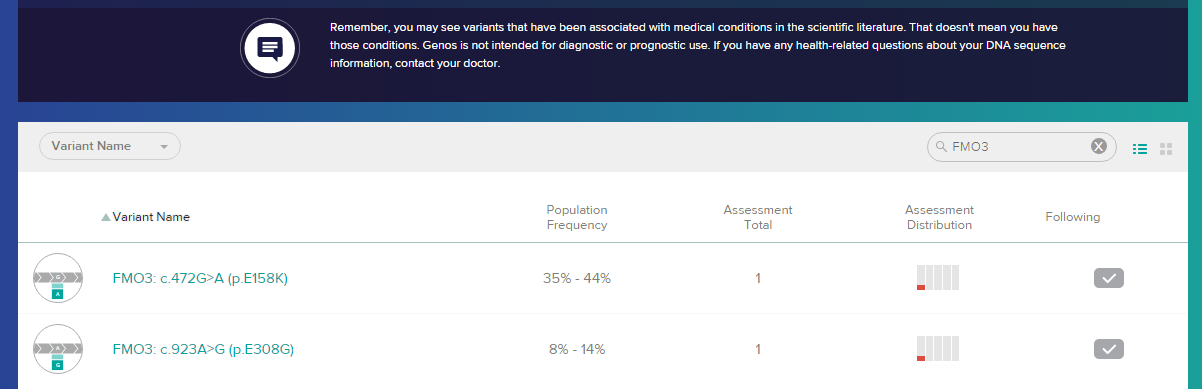
For FMO3 the test listed my 2 'wrong amino acid' variants, but not the 'silent' one.
I can't be sure it is FULL SEQUENCING, but rather a 'list of suspects'.
Overall I think it was worth it.
Best overall DNA tester I know (being both for consumer and none of the obstacles of clinical labs).

I got my exome DNA results back from GENOS.
I am very happy with the service, the process, support, and the info given.
My only gripe is I am not sure if it is FULL SEQUENCING (i.e. every codon of a gene).
It possibly is, I don't know yet.

Ways DNA labs test and give results :

1. Test for list of suspect variants/codons only (usually cheapest way).
This is no use really. Still too much unknown of the other bits. This is where they test suspect codons only. This means they choose the list of known suspects, but many more variants may yet to be discovered as fault-causing. You want to know every variant you have, not just suspects.

2. FULL SEQUENCING, but only give SELECTED variants/codons info to the person.
This means they tested every codon but they may only give what they think is relevant info on certain variants. So you still can't be sure you are getting the whole picture.  

3. FULL SEQUENCING and give ALL VARIANTS whether they be thought relevant or not.
This would be as good as FULL SEQUENCING in theory I guess.

4. FULL SEQUENCING (i.e. every codon of the gene)
This is best/good, though I guess in theory you only need to know the variants, so #3 may be more practical. #3 is the same as #4 but without the 'perfect' parts (which presumably won't affect function).

I am hoping Genos is #3, but I have not found out yet. It may be #2 which would not be so good.

EXOME, GENOME :
Exome  = coding for all the proteins in humans
Genome = everything (Exome + Junk + promoter regions etc)

It's thought maybe 80% of faults are in the exome part.
The main reason for EXOME testing rather than GENOME is cost (at the moment).
Exome is obviously the part you can't do without. The essential part.
But people can have faults in the junk part of a gene and it can cause deficiency even though it's junk.
   
MY GENOS DNA RESULT
I have fully sequenced the FMO3 gene before so knew my FMO3 coding part result.
It spotted my 2 carrier copies of the common variants at codon 158 and 308.
These are reasonably common (in caucasians anyway).
There is debate if they affect function (obviously I would say they do).
Some say only if they were from same parent, or if person is homozygous (carry 2 copies).

It didn't spot a silent variant I carry. This is what makes me wonder if they only test a 'suspect list'.
Silent variants are where one of the nucleotides is wrong but the amino acid ends up the same.

FMO3 gene
532 x 3 (1596) nucleotide sequence.
makes up 532 amino acid sequence (+ stop at 533).
makes up the FMO3 protein.
Which means 532 codons where variants can be.

Clinvar list of FMO3 variants

IS IT A GOOD WAY TO DNA TEST FOR FMO3?
Well this is where I don't know (yet).
The best way is to have your full 532 coding sequence, or at least all the variants in that 532 coding sequence (even if they are currently deemed to not matter).
But I don't seem to have the full sequence (not that I can see so far), or all the variants (as they missed a silent one).
The give a raw file but I don't know how to open it.
Answer : I think so but I don't know.

FMO3 DATABASE
In my opinion we should get a FMO3 database going.
But how to, I don't know.
Ideally this would be both the Exon and Intron parts of FMO3 (not just the exons)
Intron is the 'non-coding' part of the gene (which could be junk + promoter region etc).
This would be a pipe dream.

My philosophy on spending on 'systemic malodors'
My philosophy is we don't know what causes it yet, so better to spend money on testing rather than spending on supplements.

FINAL COMMENT
So I can't say for sure GENOS is a great option for DNA testing, but it may be.
And at current price $399 it's cheaper than most FMO3 DNA gene testing .
Plus it's meant for the public and easy to test (saliva).
The question is how much prices will drop quickly and how well competitors do.
In the end you will probably be able to do GENOME testing for maybe $100, but when ?
Also remember, you may find results of other genes you might not want to know (e.g. prone to parkinsons, carrier of cystic fibrosis) so you need to factor in whether you want to know such things.

Note :
I am no expert, so terminology, facts may be wrong.

Links :
Genos DNA TEST LAB FOR CONSUMER


Get new posts by email

25 October 2016

Bacteroidetes don't produce trimethylamine from choline

 2012 paper suggests bacteroidetes phyla are poor at degrading choline to trimethylamine.
Firmicutes, Actinobacteria, and Proteobacteria can produce TMA.
Ubiome suggest Firmicutes make up 60% of normal flora, Bacteroidetes 30%.
My own Ubiome results average (of 4) were Firmicutes 70%, Bacteroidetes 26%.
My own opinion, not enough known of the gut flora for me to have an opinion.
This post more a 'for your information' post, rather than any 'breakthrough'.
Perhaps others should try stool DNA testing.

The new Phillips/Shephard TMAU-FMO3 overview paper mentioned a 2012 paper which they seemed to have great credence for. The research in the paper proved TMA could be produced from choline by certain gut bacteria flora phyla (Firmicutes, Actinobacteria, and Proteobacteria) but not from Bacteroidetes.

Quote from Phillips/Shephard/Fennema paper

Free choline is absorbed throughout the small intestine and is subsequently integrated into cell membranes or actively taken up by the liver, where it can be converted to betaine, phosphocholine, or lecithin (Zeisel, 1990). High amounts of choline may exceed the absorptive capacity and pass through to the large intestine, however, where it is metabolized to methylamines by microbial action (Zeisel et al., 1983). Choline is a quaternary ammonium compound containing a trimethylammonium moiety. Thus, it can act as a precursor for TMA (Zeisel et al., 1989; Chalmers et al., 2006). The bacterial conversion of choline to TMA involves the cleavage of the carbon-nitrogen bond of choline, producing TMA and acetaldehyde (Hayward and Stadtman, 1959). Craciun and Balskus (2012) proposed that a glycyl radical enzyme CutC (EC 4.3.99.4), encoded by the bacterial choline utilization gene cluster (cut), might act as a choline TMA-lyase to catalyze this initial step in choline degradation (Fig. 1). This was confirmed by demonstrating that deletion of cutC in Desulfovibrio desulfuricans abolished the ability of the organism to produce TMA from choline. Bioinformatics analysis revealed cutC homologs in 89 bacterial genomes. The homologs are not distributed evenly among the major bacterial phyla of the human gut, being present in Firmicutes, Actinobacteria, and Proteobacteria spp. but absent from Bacteroidetes (Craciun and Balskus, 2012). Table 1 shows bacteria known to be associated with formation of TMA via choline degradation.

This is the paper they refer to :
Microbial conversion of choline to trimethylamine requires a glycyl radical enzyme

Firmicutes and Bacteroidetes seem to make up the bulk of the gut flora. There seems to be different opinions on what that % make-up should be for a healthy gut.

Ubiome suggest the healthy gut should have about 70% Firmicutes and 30% Bacteroidetes.

My own Firmicute/Bacteroidetes ratio :
I have tested with Ubiome 4 times.
In 3 samples my Firmicute was slightly higher than normal. Bacteroidetes was slightly lower.

My view on the knowledge of the human gut flora :
I would suggest if you compare it to the history of USA, it may be around the year 1620. Perhaps I'm wrong, but my impression is so little is understood of the gut flora (Oct 16). I'm hoping technology has caught up and we will be at around year 1900 in the next few years.

My view on my own results :
I will not be excitedly trying to alter my firmicute/bacteriodetes ratio, though may look around for info. It seems that bacteroidetes are not the type usually put in 'probiotics'. Possibly partly as they are so 'sensitive' (and die easy in oxygen). Possibly there is no 'bacteroidetes' probiotic on the market. The general view seems to be taking 'prebiotics' is the best hope of feeding bacteroidetes.

Perhaps others can do the stool DNA test :
Since the stool  DNA test is relatively cheap, and sometimes they do special offers (e.g. 3 for 1), perhaps others with systemic body odor/halitosis can do the test and mention anything they want about the results in the comment section of this post.

Stool DNA test suppliers :
Ubiome (choose citizen science)
American Gut (also 'UK Gut')

These are the 2 best known suppliers. Thankfully, they are consumer health friendly, and not health learning obstacles as is the case with normal DNA tests, urine tests etc. The spirit of the testing would be that it may be not very useful, but perhaps will be in hindsight.    

What's this to do with systemic body odor ?
My own view is that most cases of SBO are probably due to enzyme weaknesses, probably the bulk of which are due to sub-par FMO3 enzyme function. But I also think gut dysbiosis will be a common factor in 'FMO3 body odor', probably as part of the syndrome, and perhaps often the 'tipping point'.

Currently TMAU is the only acccepted form of systemic body odor. My own view is that 'FMO3 body odor' can mean smelling of any FMO3 substrate rather than just TMA, and many of the volatiles produced in the gut are probably FMO substrates. Although this paper was about TMA, perhaps bacteroidetes can't produce other FMO3 substrates, but who knows.

Get new posts by email

23 October 2016

new TMAU review paper by Profs Phillips and Shephard

New TMAU, FMO3 overview paper by Profs Ian Phillips and Elizabeth Shephard (and Fennema).
Probably leading world experts on FMO3 and TMAU.
Overview paper probably contains no new info.
Perhaps Fennema is a student of theirs and did the paper as coursework.
Mentions the TMAO - CVD theory but downplays the connection.

Prof Phillips and Shephard (husband and wife) of London have long been experts in FMO3 and TMAU. They have published many papers on the subject, most probably overviews rather than new research. Fennema is a new name in the TMAU world. Perhaps they are a student of theirs, doing the paper as coursework.


CVD - TMAO theory :
One new issue they write about is the CVD - TMAO theory which was first put forward in 2011 by Hazen et al. My reading of their interpretation is that they are sceptical, and think that TMAO levels may be more a biomarker of general dysbiosis related to obesity, rather than TMAO being the cause of CVD.

Gut flora composition (Bacteroides produce less TMA) :
They also mention that 1 or 2 papers may associate TMA levels with the Firmicute group, and Bacteroide group don't tend to produce TMA as much. At the moment my impression is so little is known of the gut flora that I don't take anything as agreed beyond doubt yet. So it's not something I pay much attention to currently.

Final thoughts :
New TMAU / FMO3 papers are always welcome, and it's a decent overview, but doesn't really add anything new. I'm guessing Fennema is unlikely to publish new TMAU papers if they are a student (except during coursework).

Acronyms :
CVD : cardiovascular disease


Get new posts by email

12 October 2016

TMAU searches up to 12,100 a month (maybe)

Post about the popularity of the search terms tmau' 'trimethylaminuria' and 'fish odor syndrome' in google searches.

It seems they have doubled in 6 months (if the data is correct).

In a previous post about 6 months ago it seemed that searches for the keywords 'tmau' ' trimethylaminuria' were around 6,500 each, according to a program that says it monitors keyword search stats.


With the same program, the stats for the search keywords now are :

Keyword search stats per month
TMAU/tmau : 12,100.
Trimethylaminuria : 12,100.
Fish odor syndrome : 2,100.


This is quite a rise (if correct), though 'google trends' seems to show these keywords keeping quite steady over the last 90 days.

Keyword search data :
It sued to be quite easy to get an idea of google keyword search popularity from a public google stat page, but this was stopped about 2 years ago. One now needs to look around for keyword stats. This program claims to give good info (possibly from the same google data), although the google 'trends' for the keyword stats don't seem to entirely match.

Google Trends : Link to graph page below
Google trends is a public webpage where you can get an idea of keyword trends.

Below is the 90 day trend graph comparing keywords :
Trimethylaminuria.
TMAU.
Fish odor syndrome.


The trends :
The 90 day graph doesn't seem to match the 12,100/month count, but can reach maybe 100 a day.
I wonder if the term 'fish odor syndrome' has become an outdated term of search, or is more common search among 'normals'. Who knows.
TMAU : hopefully this will be the popular term that takes off (for trimethylaminuria) as it's the shortest. People seem to often misspell it as TAMU. In the trend it seems the most common term (only slightly).
The 90 day trend doesn't look like it is increasing much. The 12 month / 5 year comparisons also give conflicting stats, so 90 days was used for this as it's the longest that seems to use daily counts.

Advertiser bid prices / Cost per click (CPC)

The CPC is the general price an advertiser will pay for someone to click an ad.

CPC for :
Trimethylaminruia : $1
TMAU : $1
Fish odor syndrome : $0.02


TMAU and Trimethylaminuria seem to be pretty high value, meaning ads expect to get a decent return from clicks. That's a good sign for the community as in the end google is about ad revenue sales and means these terms are valuable to them. It looks like these 2 terms are bundled together in the sense their stats are exact same. Maybe ad buyers are tending to buy up both terms when they buy ads.

It's been noticed that ads on youtube videos about TMAU recently have had what an outsider might think of as very targeted ads. examples : charcoal, probiotics. So it looks like 'ad buyers' are getting quite targeted about what may interest viewers (or at least, they may buy). I'm guessing the TMAU community probably is quite 'receptive' to ads for supplements etc, even if it's unknown if they help.

It's interesting that the term 'fish odor syndrome' is worth only 2c. Either a sign it's not a common search or the ad buyers don't pick up on that term. Most in the community would probably rather this term would fade away as it does not describe their smells, but my guess is that TMA alone probably only smells of 'dead fish'. The other smells are probably other metabolites/volatiles (in my view). But overall it's probably best this term fades as it's misleading to those searching.

Final points :
It's uplifting that these search terms have doubled in interest over the last 6 months (if the data is right). Still probably pretty uncommon but making an inroad when people think of B.O/halitosis. Perhaps someday TMAU will be an insult in every school class, which of course would be bad but at the same time then the whole world would know about the concept of systemic body odor.
 

Get new posts by email

4 October 2016

Young Mom TMAU Youtuber

This young American mom has started a youtube channel about TMAU.
Looks like she plans to update the channel quite regular.

Note : This video is an embed from source.
If video is deleted it will auto delete here too.
As TMAU is so taboo, quite often people delete videos in hindsight.

Visit her channel here : click link 


Get new posts by email

18 June 2016

How much DMB for TMAU ?

What daily dosage of DMB should a TMAU patient take to block TMA formation in the gut each day ?

Answer (estimate, in theory) : about 10-20g DMB a day (divided into doses) 

About this answer :
This is an estimate by a very respected CVD expert in a recent overview paper of the TMA-oxide - atherosclerosis connection proposed by Hazen et al in 2011.

Answer is based on Mouse studies for atherosclerosis :
The answer is not based on humans taking DMB as trials have not reached that stage. It is an estimate based on extrapolating the dosage given in mice studies. So you could say it is a 'expert estimate based on mouse studies' given the current info.

The estimate is generally from this overview paper : link

Acronyms

DMB :  3, 3 dimethyl-1-butanol
TMAO : trimethylamine-n-oxide
TMA : trimethylamine
CVD : cardiovascular disease
FMO3 : flavin mono-oxygenase enzyme (isoform 3)
About DMB :
DMB in this case refers to 3, 3 dimethyl-1-butanol.

Atherosclerosis and TMA-oxide theory :
Put forward by Hazen et al of Cleveland Clinic in 2011. My impression is that the theory is that TMA-oxide may be the main factor in the development of atherosclerosis.

Connection with TMAU :
Since TMAU is proposed as being a malodor caused by TMA, any research that may block TMA formation in the gut would be a potential therapy. This is an obvious target for the 'atherosclerosis researchers' to aim for. So TMAU patients should be incidental benefactors of this approach.

Where do you humans get TMA from ?
TMA is smelly so is not normally consumed by humans. Nor is it a metabolite from human metabolism. It's only real source in humans is gut flora altering certain compounds in the diet (e.g. choline, carnitine, lecithin, TMA-oxide in fish).

The 'TMA blocker' story so far :
Hazen et al lead research into the TMAO - CVD theory. In Nov 2015 they published a paper showing DMB blocks TMA formation in mice (gut).

How long until a 'TMA blocker' drug is available ?
Cleveland Heartlab have already signed a deal with Proctor & Gamble to market an 'over the counter' TMA-blocker drug. It is not known when this will be available. I am currently presuming it may be DMB based, but perhaps they will find an even better 'TMA-blocker'.  

How can you get DMB now ?
DMB is a natural compound in things like balsamic vinegar, olive oil, red wine etc. I do not know how much you would need to take to get 10-20g daily of DMB. My own view is that these foods are probably bad for people with FMO3 issues, as they will likely contain many other FMO3 substrates that may end up causing smells (probably indirectly after being altered by gut flora).          

My own view :
I am very optimistic about a 'TMA-blocker'. But my own belief is that people with an FMO3 issue probably smell of all FMO3 substrates and not just TMA. So that concerns me but I am still optimistic. Also FMO3/TMAU was a very neglected disorder, but now TMA metabolism in humans is on the center of radars for atherosclerosis researchers. I will certainly buy DMB when available. If I thought TMA was the only malodor problem I would be ecstatic.

It also shows how TMAU/FMO3 has been a neglected disorder, as this therapy is an obvious concept which was never looked at for TMAU. Now that it is proposed to be connected with CVD we can expect lots of research into TMA metabolism.

My feelings on this (in tags) in relation to metabolic/systemic malodor :
optimistic, excited, cautious, research leads could appear from anywhere now, TMA metabolism is on the radar bigtime.


Get new posts by email


26 March 2016

Cassie TMAU video : Channel 5

Cassie's TMAU story was on UK TV Channel 5.
Program title : Medical Mysteries, The woman who smells of fish.
Aired March 2016.

The video (youtube) can be seen below
Note : due to copyright, this copy is blocked for UK viewers.
Update : Video now seems to be viewable in UK. 


UK viewers, you can watch video copy on Daily Motion


My comment :
Cassie done a great job on the show. The TMAU story was only about 8 minutes of a 50 minute program, but a few things make me think 'TMAU' may be a 'seller' when it comes to these types of programs ('weird' health disorders):

1. It was the first show of a new program and they named it 'the woman who smells of fish'
2. The production company 'Tigress productions' have done a TMAU documentary before and may have got a lot of feedback previously.
3. The program was mostly about the other 2 stories (20 minutes each ?) but was named about 'smelling of fish'. So even though it seemed to have last priority it was used as the 'bait'.
4. My understanding is that 'woman who smells of fish' was trending on twitter UK in some areas when it was aired.      
5. The show got a reasonably 'peak viewing' time (Thursday 8pm)

Dr Lachmann appeared on the show (as producers tend to go for him as the 'health professional expert', partly since there are so few I guess) and made some good points :
1. Most do not smell when seeing him. He said it was because they probably already do a lot of stuff to avoid smelling but imho it's because most of us are naturally very 'transient'.
2. Most complain of fecal and garbage smells. I guess he said this due to it being by far the most common complaint. IMHO it's because they will smell of many sulfides and amines oxidized by FMO3, but at the moment no expert would be prepared to say that or maybe even believe it.
3. One or 2 visit him a week. I presume he means new referrals (?) but maybe not. And this is only the ones in the area eligible to visit him, as well as taking the time to find out about him and follow it up via their GP.  

He made a few other points such as 'it's rare' (which I don't agree with) and Drs mostly know nothing about it (true).

Video has 2,600 views in 1 day
I uploaded the video yesterday and despite being blocked in UK it has had 2,600 views in 24 hours. My best video before this was Claire's video which has 75k views since 2010. For some reason it seems to have caught on in a way the other videos haven't, seemingly to a wider audience (relatively). Currently I don't know where the main sources of the traffic is coming from. I wouldn't say it's went 'viral' but it's getting a good steady flow of viewers (will keep you updated).

So thanks to Cassie for doing the show. It's looking like it will be a great source to raise awareness of TMAU which is very much needed.          


Get new posts by email


19 January 2016

1st mention of DMB pill to block TMA

Dr. Mike Roizen, is chief wellness officer and chairman of the Wellness Institute at the Cleveland Clinic and co-writes a regular health column for the Buffalo News. In the latest column he mentions a 'DMB pill' to block TMA formation in the gut from choline.

We know that the Cleveland Clinic Heart Lab has signed a deal with Proctor & Gamble to issue an OTC product for 'TMAO management'. Until this article we had to guess it would be a 'DMB pill', but this seems the first public mention by anyone close to the researchers that this would be the case.

They also give some guidelines as to how you can get DMB naturally in your diet.


Get new posts by email


5 December 2015

YouTube : Another young lady talks TMAU


Another young lady has posted a video talking about living with TMAU. This greatly raises awareness, Thanks to all the people who post videos on the subject.

This is an embed of the video. Should the original be deleted this one will auto-delete too.


Get new posts by email


15 October 2015

Prof Dolphin posting on UK TMAU forum


Professor Colin Dolphin has posted again on the tmau.org.uk forum. He posts there occasionally. He was a member of the research team who first documented the FMO3 gene coding sequence (circa 1998?) and has a long interest in TMAU/FMO3.

He posts there as 'FADworker'

new Prof Dolphin post

He has his own section in the forum :  'Questions for Dr Dolphin'


Get new posts by email


2 August 2015

Prof Colin Dolphin post about potential TMAU therapies

Prof Colin Dolphin is an English academic who has had a long-term interest in FMO3 enzyme and TMAU. I believe he was one of the team who documented the FMO3 gene coding sequence in the late 1990's

Occasionally Dr Dolphin writes posts on the tmau.org.uk forum for TMAU people. Indeed he has been given his own thread there : Questions for Dr Dolphin

Recently he posted an in-depth post about potential therapies for TMAU and the obstacles.

Dr Dolphin's tmau.org.uk post about potential TMAU therapies : link

My non-expert interpretation of  the post :

The post suggests 3 potential TMAU therapies and their obstacles :

1. Using bacteria that can oxidize TMA in the gut to TMA-oxide
Obstacle : these bacteria tend to be aerobic (need oxygen) and do not tend to survive well in oxygen-deprived areas (such as the gut)

2. Genetically modifying gut-friendly bacteria with enzymes that oxidize TMA to TMA-oxide
This would seem more possible, but the TMA-oxide may be quickly 'reduced' back to TMA by other gut bacteria enzymes. So it would be a cycle of TMA-TMAO-back to TMA.

3. A drug that blocks the production of TMA from choline/carnitine etc.      
Again seems possible but may involve taking many drugs and not really practical ?

Dr Dolphin mentions a final idea where the aim would be to eliminate TMA-producing bacteria in the gut (?). He also mentions how he applied for a grant to check the gut flora of TMAU population against normal people but the application was unsuccessful.


Get new posts by email


11 July 2015

Herbal Hill deodorant range : A project to raise funding

Herbal Hill
Regular readers may be aware that a small research company known to the metabolic malodor community, Trinzyme, is looking to develop a therapeutic that may be helpful to the metabolic malodor community.

However, much funding will be needed to do the research. For that reason they are looking at various ways to raise funding for the research. For that reason they have developed a range of deodorizing products that are aimed at helping with malodors. The brand is called 'Herbal Hill'. The founder is in touch with us about this project.

Herbal Hill products are in their very early stages of development.
link : Herbal Hill website   

Perhaps one way of looking at this project is that it is in it's 'alpha stage' and of course it is a means to an end in that it is hoped to be a source of funding for a therapy in the long-term.

Secrecy :
It is the standard practice for research companies to be very coy about making information public, especially in early stages, due to concerns such as patent theft etc. So it is is difficult to make much information public, hence the secrecy. It is frustrating for everyone but pretty standard for the industry. This explains the lack of public info. For instance, quite often those with info are asked to sign confidentiality agreements before discussion.


Get new posts by email


re Email sub service : Google is stopping this service JULY 21 new post emails will no longer happen

TMAU Stories

systemic BO/halitosis important links

MEBO Research malodor study 2016

Youtube

FMO3 reference

Blog Archive

TMAU/FMO3 research

Systemic Body Odor links

email :
sysbodyodor@gmail.com

Do you have systemic body odor ?

FMO3 Survey Form

FMO3 DNA test result survey
for those who have FMO3 DNA tested
survey still OPEN

TMA blocker pill (links)

P&G - Cleveland press release aug 2015
1st mention of 'DMB pill' dec 2015
FMO3 DNA testing
Update Aug 17 :
Genos is back with it's EXOME test
link

Note :
Exome/Genome testing may be better option than single gene testing.

See this post : link

Note : Genos Exome Testing.

Exome testing is almost the same price now as single gene testing. Also Genos is consumer friendly, which standard DNA labs are not.

So the blog offer to test solely for FMO3 is almost obsolete, and so no longer offered.


Does Genos fully sequence FMO3 gene ?

At the moment it is not clear, but hoped this will become clear over the next few months

Note : possible 'wild west' way of testing FMO3
Use an ancestry dna site and rummage through the raw data

TMAU Webinar #5 : Preti et al