News & Views on Systemic Body Odor and Halitosis such as trimethylaminuria TMAU. If you have fecal odors or bowel odors it may be metabolic/systemic

Showing posts with label metabolic malodor. Show all posts

2 January 2018

Wevers & New Halitosis disorder : DMS and CH3SH

A new paper by Drs Wevers, Winkelman, Tanger et al, puts forward the theory that there is a newly discovered disorder that can cause metabolic/systemic halitosis.

The volatiles that cause the smells : DIMETHYLSULFIDE and METHANETHIOL .
Enzyme at fault : SELENBP1 .

title : Mutations in SELENBP1, encoding a novel human methanethiol oxidase, cause extraoral halitosis
Pubmed Abstract :  link
Full paper : Link

First impressions of this new paper/discovery :

1. IMHO it could be classed as the MOST IMPORTANT METABOLIC BODY ODOR DISCOVERY SINCE THE 'DISCOVERY' OF TMAU IN 1970.
The reason being that the concept of 'metabolic/systemic body odor' has relied on 1 compound (Trimethylamine) to prove the concept and be the 'sole' disorder, so more compounds to the list are welcome.
In a perfect world society would say 'let's now find all the metbo compounds' ... but society is not interested.

2. They feel that the gene to blame is SELENBP1 for this new disorder.
I still suspect FMO3 is to blame, so I will keep an open mind for now.

3. DMS and CH3SH are the compounds to blame for this disorder.
People with 'fecal body odor' (as it's known) complain of smelling of many nasty smells. To me, DMS and CH3SH are far better suspects for causing FBO rather than TMA, and they are probably in my top 5 list of potential FBO smell suspects, so to see them identified is very welcome.
I suspect there may be a few more (probably mostly Volatile Sulfur Compounds, thiols') suspects to add to the list, but I regard these 2 as potentially 'main players'.

My example list of FBO suspects (guesses):
Probably VSCs or Thiols ... e.g.

DMS
Methanethiol
Dimethyldisulfide
H2S
Cysteamine (?)
Way down the list .... TMA

When someone has metabolic BO, the 2 questions are :
1. What compounds are causing the smell ?
2. What enzyme(s) are supposed to neutralize those compounds.

So in this case I think they have identified bigger 'players' of the group of compounds that cause FBO, but wrong enzyme (could be wrong).


The 'urine' test for the new 'metbo disorder' : High Dimethylsulfoxide.
For the urine test they go for DMSO level.
Perhaps DMS and CH3SH are too volatile to rely on in a urine test, and may already have dissipated or altered. They seem to go for the OXIDE of DMS, which is perhaps the natural end product, and judge it on higher levels.
I would suggest this is definitely a test we should take.

About Wevers, Tangerman, Winkel et al :
The paper included the 3 above Drs, as well as many others. They have known to have a long interest in the causes of Halitosis, including metabolic causes.
That said, this paper may have taken 10 years (or more) to publish, so my 2 thoughts on their research are :
1. Whilst I welcome it, I am not relying on any breakthrough in society and Drs knowledge of met BO/hali in the near future.
2. I'm hoping perhaps they have 'stored' research and will announce treatments, test options, as a quickfire bundle of announcements this year, but I'm doubtful.

So in conclusion, my current view is :
Potentially 'top of the list' compounds identified to cause metbo body odor.
For now, I'm still a 'FMO3ist' rather than thinking it is SELENBP1.

Them :
compounds : DMS and CH3SH.
enzyme : SELENBP1

Me :
compounds : DMS and CH3SH (and a few more VSCs, thiols etc).
enzyme : FMO3   

Other potential metbo disorders :
I write mostly about my opinion as to the cause of FBO, which seems the main complaint.
I am sure there will be other metbo disorders, but these will be limited to perhaps 1 compound (or a small family), and to other genes.
FBO seems a wide spectrum of smells, so IMHO is most likely a 'broad spectrum' gene, whereas other metbo genes will have a  one distinctive smell (probably), such as isovaleric acid.   

What compounds make feces smell ?
Everyone knows the smell of poo can vary, so for the most part it seems that the compounds that make the smells are varying too. A guess would be they are mostly VSCs / Thiols, and a few other compound families thrown in. But for the most part they would seem to be sulfur compounds.
It may be a surprise to know the World Scientists do not yet have a definitive list of the compounds that make poo smell. Occasionally a researcher (such as Levitt et al) will do a few papers, but many might disagree with them.   

Media links to the story
Gizmodo
Medical Xpress
Science Daily
Genengnews
UCLA press release

Dr Wevers webpage


Get new posts by email

3 September 2017

Mice on high choline diet deficient in choline : Paper

This could be a very important paper for the following malodor problems :
TMAU (if you believe that TMA is the sole source of your malodor).
Possibly 'FMO3 malodors' (if you think many FMO3 substrates cause your smells).
Possibly (in theory), if low blood choline caused smells (this is an unknown).

2017 Paper :
Metabolic, Epigenetic, and Transgenerational Effects of Gut Bacterial Choline Consumption
Romano KA et al
Unis of Wisconsin and Harvard

in the news : link


Summary
Choline is an essential nutrient and methyl donor required for epigenetic regulation. Here, we assessed the impact of gut microbial choline metabolism on bacterial fitness and host biology by engineering a microbial community that lacks a single choline-utilizing enzyme. Our results indicate that choline-utilizing bacteria compete with the host for this nutrient, significantly impacting plasma and hepatic levels of methyl-donor metabolites and recapitulating biochemical signatures of choline deficiency. Mice harboring high levels of choline-consuming bacteria showed increased susceptibility to metabolic disease in the context of a high-fat diet. Furthermore, bacterially induced reduction of methyl-donor availability influenced global DNA methylation patterns in both adult mice and their offspring and engendered behavioral alterations. Our results reveal an underappreciated effect of bacterial choline metabolism on host metabolism, epigenetics, and behavior. This work suggests that interpersonal differences in microbial metabolism should be considered when determining optimal nutrient intake requirements.
in the news : link

My interp
It seems they wanted to see how mice differed between groups that had 1:abundant bacteria that turn choline into TMA ... and 2: mice that had a cloned enzyme that blocked microbes changing choline into TMA.

The results were
The TMA-microbe rich mice had low choline blood levels even on a normal choline rich diet.
This is because the gut microbes COMPETE with the host for choline (and microbes get first go).
This caused significantly lower METHYL DONOR metabolite levels in blood and liver, as choline is one of our main methyl donors.
The low blood methyl/choline levels in blood seemed to cause behavioral problems (e.g. anxiety).

Choline
Seems to be one of our main METHYL DONORS (in the blood).
Is an important fat decongestant for the liver.
As we can make some, it was regarded a non-essential nutrient, but now it is accepted that we cannot make anywhere near the amount we need, so is in effect an essential nutrient.

Behavior problems
It's interesting they report the 'low choline blood' mice as having behavior issues such as anxiety, as many with TMAU report of anxiety.

My thoughts
I have thought this before, that low choline blood may be an issue for anyone with 'TMAU' who eats a high choline diet, or even worse for someone following a low choline diet.
As said, choline is important for the liver and as a methyl donor.

NAFLD
I do wonder if perhaps those with TMAU are prone to non-alcoholic fatty liver disease. Perhaps in general or in a particular way. Very speculative.
Many Drs feel that most westerners will have some fatty liver say over 40+, due to diet and lifestyle. But perhaps low choline could be an issue.

Appropriate tests :
1. I guess a liver ultrasound to see how the liver is. (mainstream test)
2. Choline blood test. This is not mainstream and seems very hard to find. It should be mainstream but it's not.

What can a TMAU person do to raise choline blood levels ?
It would seem impossible as the choline will be altered to TMA before it is absorbed.
One choline expert suggested phosphatidylcholine was less easy for microbes to alter, and may be worth a try (unlikely ??).
My own view is that testing for choline blood level would be the best option, so we could see if there was a 'syndrome' common to us.

TMAU low choline predicament (my theory)
2 scenarios
1. High  choline diet (normal west diet) > TMA microbes eat the choline before they are absorbed > person has low blood choline.
2. Person goes on low choline diet > even lower in blood choline level.

They cloned an enzyme in the microbes that did not produce TMA
I note they mention they had an enzyme cloned and put into microbes that stopped production of TMA.
My guess is this approach would be an obvious therapy for TMAU.
Something we should certainly investigate.
My opinion : PROBIOTIC THERAPY with CLONED MICROBES that don't carry CHOLINE-TMA enzyme is one of our best hopes.

Could low choline blood levels cause the smells ?
I guess it's possible that LOW CHOLINE BLOOD levels could cause the smells for metabolic/systemic malodors to do with related enzymes (e.g. FMO3) , but for now it must be deemed an outside chance but definitely one worth following up.

My advice for now 
Try and find a test supplier to do the choline blood test (possibly very difficult).
And perhaps a liver ultrasound to see if you have some fatty liver.

 Get new posts by email

5 March 2017

TMAU : Choline status should be tested

Campaign.
TMAU test protocol.
Add CHOLINE status as part of a 'TMAU profile screen'. 
Who to campaign to : National Health Systems.
My hope of success : currently about 5% ?

Currently those who think they have TMAU (trimethylaminuria) do the TMAU clinical test (the urine test). This tests levels of trimethylamine and it's oxide (TMAO).

It is known that choline is closely associated with TMAU. The theory is choline gets changed to TMA in the gut. This makes me wonder if TMAU people may often have a natural blood choline deficiency despite taking choline.

Choline currently seems to have a quasi status as an essential nutrient, Probably in time it will be regarded essential. It seems to be a good emulsifier of fats in the liver. This makes me wonder if TMAU people may be naturally prone to non-alcoholic fatty liver.

Many 'normal' people have NAFL, but it would be interesting to see what the % was in TMAU people. Maybe it will turn out low choline plasma is a cause.

Targeted TMAU profiles tests :
So my first 3 tests for a TMAU profile test would be :
TMAU urine test (I would do DNA test as well).
Choline plasma test.
Liver ultrascan (to look for NA- fatty liver)

Other speculative tests I can think of  (quickly written) :

Very speculative other tests for a TMAU profile :
Leaky gut test.
Ethanol test (to detect candida). Now no longer available (from Biolab UK).
Microbiome stool DNA test.
Biotin test (as I was once deficient in biotin).

I would add many others, but perhaps the first 3 are a realistic aim to convince conservative metabolic consultant for a TMAU profile.

Re ethanol test.
This was a test done by Biolab UK where you had to attend the lab. Ethanol is proposed as being generated only by yeast in humans.
I see now they have discontinued it, and refer people to do microbe organic test by Great Plains, which I don't think is as accurate (or at least, not a decade ago).  

Ultimate biochemical test for Systemic Body Odor :
A broad screen of volatiles known to cause systemic body odor. Currently they don't know the list of volatiles, so at this time this would be EXPLORATORY.
Once it was known what volatiles cause systemic body odor, they could then create a profile test with these volatiles.
Likely suspect volatiles (my guess) : dimethylsulfide, dimethyldisulfide, trimethylamine (small player).

Get new posts by email

1 March 2017

New paper : TMAU might not just be FMO3 disorder

New TMAU paper by Monell et al.
Conclusion (?) : TMAU might not just be because of FMO3 enzyme.
Paper funded by NORD grant crowdfunded by TMAU community in 2011.

Around 2009-2011 a TMAU community group spearheaded a crowdfunding campaign to get the NORD TMAU grant past it's $25K trigger point so that researchers could put forward proposals for the grant. The grant was awarded in 2011 to a Monell Chemical Senses proposal. This month the paper has been published in a peer journal.

NORD grant TMAU paper : Genetic analysis of impaired trimethylamine metabolism using whole exome sequencing

Conclusions
Thus, variants in genes other than FMO3 may cause TMAU and the genetic variants identified here serve as a starting point for future studies of impaired TMA metabolism.

My interp of the paper 

My interp is they are saying genetic TMAU may not just be just to FMO3 enzyme flaws. In particualr they mention PYROXD2 enzyme, which has been mentioned in TMAU circles before (can't recall why).  

My own view on the paper (bad analogy ... suspects and safehouses)
If you think of 'volatiles' as the suspects, and FMO3 as the safe-house, they are saying the suspect (TMA) stays at various safehouses, TMA is to blame for all the smells, and only TMA should be followed about even when it leaves FMO3 'house' to other safehouses.

My own current view is the only safehouse to watch is FMO3, and note all the 'volatiles' that stay there. In fact I reckon TMA is a 'small player' and other FMO3 'safehouse' suspects are more likley to blame for smells. Probably the likes of dimethylsulfide.

So this new paper has went in a direction that doesn't fit with my current thinking, but it is 'new' in that they are suggesting TMA might be metabolized by enzymes other than FMO3 (?).

Paper view
Current Safehouse : FMO3
Suspect : TMA is only suspect.
Paper : TMA might have other safehouses.

My View
Safehouse : FMO3
Suspect : many. TMA a small player
My view : No need to follow TMA. FMO3 is only safehouse that matters, Keep an eye on the all suspects at FMO3 house.

Overall, I think so little research has gone into FMO3 and TMA that we may be at 'chapter 1' of understanding them. As this was a small one-off study, I don't expect much more 'TMAU' research on it. But since TMA has been suggested as having a connection with cardiovascular disease, perhaps TMAU people will be able to read on such research from this aspect in future.

Other comments on the paper :

None of the 10 people seem to report fishy smell. Most report 'sulfury'/fecal smells
My impression is that Monell feel TMA causes a fishy smell, but through influence have broadened this to saying TMA might cause smells more broader than that. Personally I think the smells are not due to TMA, but to other volatiles (e.g. sulfides), and in a way TMA is probably a 'small player' but a good biomarker of FMO3 function (? not even sure about that).    

Only one has FMO3 mutations that would be regarded by clinicians as TMAU1 
In academia and the clinical world, the teaching is that genetic TMAU is caused by serious FMO3 mutations. But in this paper only one has taught 'serious' mutations (at codon 148). Or at least, I think faults at 148 are bad. I note that they are not the worst TMAU result in the paper (at about 56%).

All the other FMO3 faults listed are carriers of common 'benign' FMO3 faults

Common FMO3 variants carried by whites by %  :
codon 158 : 20-50% ?
codon 308 -  up to 20% ?
codon 257 -  up to 15% ?

As can be seen, many people carry common FMO3 variants. Currently they are taught as being 'benign'. But in the paper, of the 10 tested, many of them only carry one of these FMO3 faults (mainly 158). Obviously 50% of whites don't have metabolic smells, so it's still an unknown full picture to understand.

The worst TMAU urine result seemed to only carry a PYROXD2 DNA fault.
In this paper, the worst result was #52 who only carried a fault in PYROXD2 enzyme.

Worst result in paper : #52 ... TMAO% output 13% ... FMO3 faults : none ... PYROXD2 faults : carries one

The worst TMAU result had no FMO3 faults and only carried 1 PYROXD2 fault. This throws up more questions than answers. 5 carried PYROXD2 faults (3 were homozygous, 2 heterozygous).

PYROXD2 faults listed : Not in coding part of PYROXD2
To make a PYROXD2 protein, you need an amino acid code. These are the codons on the exons.
Genes also have introns, which are generally regarded as 'junk' or unknown.
In this paper, the PYROXD2 faults listed are in the intronic region (not the exons). So they are not even in the coding part of the enzyme gene.

example of how gene makes a protein.
FMO3 has 532 amino acid code to make the FMO3 protein
this means 532 codons.
Genes also have intron part.
Introns not needed to form the protein, but faults there seem to be able to disable the protein.

PYROXD2 
This enzyme has been listed before in one TMAU paper. I can't recall at the moment.

Final thoughts 
The paper is certainly interesting in that it raises questions about current TMAU  teaching. How much impact it will have ... possibly not much due to lack on interest in TMAU.

I will be looking around at PYROXD2 again in a mild way. My mind is currently too set on FMO3 and all it's sulfide/amine volatiles, rather than TMA.

I have no expertise and my interp and thoughts could be wildly wrong.
My impression is Monell can be sensitive about opinions.

My own current theory on systemic body odor/halitosis
Most people identify with 'fecal body odor'. I think this is due to sulfides, maybe some amines. I think it is due to problems with the FMO3 enzyme. Probably often a combo of FMO3 slight weakness and 'FMO3 substrate gut dysbiosis'.

Get new posts by email

19 December 2016

Can FMO3 be induced by Korean mushroom ?

FMO3 experts teach that (in general ?) FMO3 cannot be induced or inhibited.
This is despite 'redox' enzymes often being induced/inhibited by foods/drugs/compounds.
A good example is a grapefruit compound greatly inhibiting enzyme CYP3A4 (discovered by accident).
FMO3 is known to be inhibited by certain indoles mainly in cruciferous veg (Cashman et al).
Also menstruation hormones have been shown to inhibit FMO3 (Cashman et al).
But still, the teaching seems to be that FMO3 cannot be induced/inhibited.

One view could be that so little is known of FMO3 (and perhaps other redox enzymes, but perhaps FMO3 is less important) that perhaps FMO3 can be induced/inhibited by compounds in food/drink/drugs. We don't know.

Paper : Korean herbal mushroom induces FMO3 
In a research paper last week, the authors seem to think they have shown that FMO3 can be induced by a Asian mushroom commonly used by Korean Herbalists.

Korean paper (University of Seoul, Seoul, Korea):
Korean herbal mushroom induces FMO3 in mice in research paper.
mushroom : Phellinus baumii

Quote :
"PBE was responsible for the induction of Fmo2, Fmo3, and Fmo4 expression. PBE also accelerated the metabolic clearance of carbendazim in vivo and so could be applied to the detoxification of xenobiotics such as drugs, pesticides, and nicotine."

pubmed link to abstract

My own view of this :
It's a one-off paper, perhaps biased to Korean herbal compounds.
I won't be looking to buy the mushroom.
The more I try herbal compounds, the worse I feel.
I think FMO3 was thought to develop in the animal/plant warfare fight, as plants developed poisons, FMO3 was developed to metabolize these (could be wrong),

But, it raises the question again about FMO3 INDUCTION as a possible therapy.

My main thought on this paper :
The notion that FMO3 INDUCTION may be worth exploring as a possible FMO3/TMAU therapy. This would be to say boost function by say 10-20%.
FMO3 induction would probably only be any use to those with FMO3 weakness/deficiency.

Get new posts by email

11 December 2016

AIRE Breath Sensor for FODMAP

Foodsniffer (not the AIRE)
A start-up called FOODMARBLE is launching a breath sensor.
Called the AIRE Breath Sensor.
It is designed for the FODMAP diet.
Detects : HYDROGEN levels ?
Hydrogen is thought to be the main gas given off during gut fermentation.
Hydrogen is used as the gas tested for 'small intestine bacterial overgrowth'.

Possible interest to those with systemic body odor/halitosis :
The blog current view is that FMO3 enzyme may be the weakness for most type of SYSTEMIC BODY ODOR (SBO).
Many of the gases from gut fermentation are probably FMO3 substrates (e.g. certain sulfides/amines).
Many with 'fecal body odor' feel they have 'gut dysbiosis'.
Something like the AIRE may help them track their 'dysbiosis' via hydrogen level.


Initial thoughts about the AIRE :
It's version 1. With hindsight it may be regarded as not very good.
BUT, people with SBO will for the foreseeable future need 'sensors' (probably breath sensors).
If it worked, it may be of some use to track 'gut dysbiosis'.
The platform (device for phone, bluetooth etc) is ideal for the consumer. A SBO sensor will be probably the same (but detect different gases e.g. dimethylsulfide).
Great price ($99 intro price). At that price it's worth a gamble.
(note : I already bought the 'foodsniffer' and 'mint breathometer' (not arrived after 2 months), so will probably not be buying the AIRE soon).

AIRE Sensor website
Twitter
Daily Mail (dec 16)
Press Release (dec 16)
Business Insider (may 16)

Systemic Body Odor needs a Consumer Sensor :
SBO will need it's own version(s) of a 'sensor'. Once it's known what gases act as biomarkers or to detect all the types of gases that cause SBO. A good 'suspect' would be 'dimethylsulfide'.
Currently such a sensor does not exist for systemic body odor.
Partly as the technology had not reached a decent level yet.
Also it seems sensor makers are only realising there was a consumer market for say 'halitosis' sensors, or hydrogen sensors. More because of start-ups getting in the market via crowdfunding.
with SBO, the person usually cannot smell themselves (my opinion, they are usually transient and the brain ignores it's own circulating smells).

One thing is for sure, SBO will need a sensor that detects SBO gases.
Currently we do not know what these gases are (apart from trimethylamine).
It's likely sulfides like dimethylsulfide will be suspects.

Fecal Body Odor :
Probably it's unknown exactly what gases make fecal smells.
Scientists will have a good idea of suspects, but papers are few and contradictory.
Perhaps for SBO, there may be a wide spectrum of sulfides/amines at any point, but perhaps a handful of 'big players' (e.g. dimethylsulfide) which could then act as 'biomarkers' for a sensor.

Possible 'big players' for Fecal Body Odor (guesses) : 
dimethylsulfide
dimethyldisulfide
methanethiol
cysteamine

FINAL THOUGHTS
The SBO community will need their own 'sensor' as they are 'nose blind' to their own smells.
The tech (and makers will) has not been there for consumer sensors.
But over the last 2 years, both the tech and now we see the will, for consumer sensors is happening.
No sensor maker would currently probably invest in a 'SBO sensor', thinking there is no market.
But other sensors may longterm make the process cheaper.
Many with SBO feel they have 'gut dysbiosis', so a sensor like the AIRE may be worth a gamble.
Keep in mind for AIRE it's version 1 (i.e. early days).  

What SBO needs
1. To find out all (or at least the main) volatiles that cause SBO (exploratory tests).
2. From that info, a diagnostic test.
3. A Sensor(s)
4. A DNA test (probably being superceded by exome/genome tests which are mathing price of single gene tests).
5. Therapies/cures.


Get new posts by email

15 November 2016

FMO3 gene results with GENOS

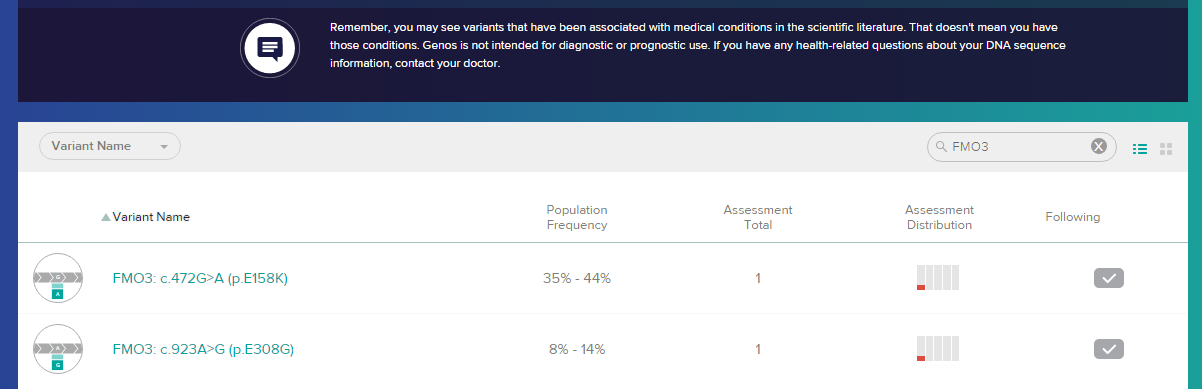
I got my Exome test results back from Genos (DNA test).
Cost was $399 (time limited special offer).
Exome is coding part of the Genome (essential part).
For FMO3 the test listed my 2 'wrong amino acid' variants, but not the 'silent' one.
I can't be sure it is FULL SEQUENCING, but rather a 'list of suspects'.
Overall I think it was worth it.
Best overall DNA tester I know (being both for consumer and none of the obstacles of clinical labs).

I got my exome DNA results back from GENOS.
I am very happy with the service, the process, support, and the info given.
My only gripe is I am not sure if it is FULL SEQUENCING (i.e. every codon of a gene).
It possibly is, I don't know yet.

Ways DNA labs test and give results :

1. Test for list of suspect variants/codons only (usually cheapest way).
This is no use really. Still too much unknown of the other bits. This is where they test suspect codons only. This means they choose the list of known suspects, but many more variants may yet to be discovered as fault-causing. You want to know every variant you have, not just suspects.

2. FULL SEQUENCING, but only give SELECTED variants/codons info to the person.
This means they tested every codon but they may only give what they think is relevant info on certain variants. So you still can't be sure you are getting the whole picture.  

3. FULL SEQUENCING and give ALL VARIANTS whether they be thought relevant or not.
This would be as good as FULL SEQUENCING in theory I guess.

4. FULL SEQUENCING (i.e. every codon of the gene)
This is best/good, though I guess in theory you only need to know the variants, so #3 may be more practical. #3 is the same as #4 but without the 'perfect' parts (which presumably won't affect function).

I am hoping Genos is #3, but I have not found out yet. It may be #2 which would not be so good.

EXOME, GENOME :
Exome  = coding for all the proteins in humans
Genome = everything (Exome + Junk + promoter regions etc)

It's thought maybe 80% of faults are in the exome part.
The main reason for EXOME testing rather than GENOME is cost (at the moment).
Exome is obviously the part you can't do without. The essential part.
But people can have faults in the junk part of a gene and it can cause deficiency even though it's junk.
   
MY GENOS DNA RESULT
I have fully sequenced the FMO3 gene before so knew my FMO3 coding part result.
It spotted my 2 carrier copies of the common variants at codon 158 and 308.
These are reasonably common (in caucasians anyway).
There is debate if they affect function (obviously I would say they do).
Some say only if they were from same parent, or if person is homozygous (carry 2 copies).

It didn't spot a silent variant I carry. This is what makes me wonder if they only test a 'suspect list'.
Silent variants are where one of the nucleotides is wrong but the amino acid ends up the same.

FMO3 gene
532 x 3 (1596) nucleotide sequence.
makes up 532 amino acid sequence (+ stop at 533).
makes up the FMO3 protein.
Which means 532 codons where variants can be.

Clinvar list of FMO3 variants

IS IT A GOOD WAY TO DNA TEST FOR FMO3?
Well this is where I don't know (yet).
The best way is to have your full 532 coding sequence, or at least all the variants in that 532 coding sequence (even if they are currently deemed to not matter).
But I don't seem to have the full sequence (not that I can see so far), or all the variants (as they missed a silent one).
The give a raw file but I don't know how to open it.
Answer : I think so but I don't know.

FMO3 DATABASE
In my opinion we should get a FMO3 database going.
But how to, I don't know.
Ideally this would be both the Exon and Intron parts of FMO3 (not just the exons)
Intron is the 'non-coding' part of the gene (which could be junk + promoter region etc).
This would be a pipe dream.

My philosophy on spending on 'systemic malodors'
My philosophy is we don't know what causes it yet, so better to spend money on testing rather than spending on supplements.

FINAL COMMENT
So I can't say for sure GENOS is a great option for DNA testing, but it may be.
And at current price $399 it's cheaper than most FMO3 DNA gene testing .
Plus it's meant for the public and easy to test (saliva).
The question is how much prices will drop quickly and how well competitors do.
In the end you will probably be able to do GENOME testing for maybe $100, but when ?
Also remember, you may find results of other genes you might not want to know (e.g. prone to parkinsons, carrier of cystic fibrosis) so you need to factor in whether you want to know such things.

Note :
I am no expert, so terminology, facts may be wrong.

Links :
Genos DNA TEST LAB FOR CONSUMER


Get new posts by email

4 November 2016

marine trimethylamine : a big source of greenhouse gas methane

It seems that trimethylamine produced in marine environments is often broken down to methane.
Methane is a main gas that cause the 'greenhouse effect' (Global warming).
Perhaps this is another reason for scientists to look at ways to block TMA formation.
Which in turn could lead to a therapy for human gut TMA formation.

TMA produced in marine environments : 
I only heard of this TMA connection. Probably marine microbes produce TMA. Apparently the TMA is broken down to methane, which is a major part of the gases that cause global warming.

I have tried to look for the % stats for sources of greenhouse gases, but not been too successful.
One site said

% methane makes up greenhouse gases : 16% (2nd after CO2).
% of NATURAL methane sources are marine : 88% (78% wetlands, 10% sea).
This does not include HUMAN sources (e.g. petrol, coal, farming).

I would guess the marine TMA is a by product of microbe fermentation, which then is broken down to methane. Ironically this has been suggested as a possible therapy for TMAU, in that some microbes would break down the TMA in the gut. I guess so few are thought to have TMAU it would not add much to the total world methane output.

But ... this means it's in the world's interest to find TMA blockers, so that TMA does not produce methane. This would probably mean interfering with the enzyme that produces TMA. Antibiotics are often 'microbe enzyme inhibitors', so it's much the same thing as antibiotics.

So maybe there is research going on to prevent methane formation from TMA to save the planet.

3 main ways TMA could be inhibited or broken down (I know of) :
1. Interfering/inhibiting the microbe enzyme that produces TMA (antibiotics often work this way).
2. 'Drugging the relevant microbes'. This seems to be the Cleveland method. They are tricking the microbes into working on a compound that is like choline but much more dificult for them to breakdown.
3. Use microbes to break TMA down via the methane pathway. Some microbes have enzymes that can break TMA down.

My thoughts on TMAU and systemic body odor
Any therapy that inhibited TMA formation or broke down TMA (e.g. to methane) would be good for anyone who thought their smell(s) were solely created by TMA. I am a bit sceptical that TMA is the only source of smells for most, so a bit worried such a therapy would not have the expected benefits. But I may be wrong.

Acronynms :
TMA : trimethylamine
TMAU : trimethylaminuria

Note :
graph and stats may be incorrect.
    

Get new posts by email

17 September 2016

Mint Breathometer ... to detect stinky breath

Mint Breathometer app and device to detect halitosis.
Available in USA from 30th Sept 2016 (can pre-order now).
$100.

The systemic/metabolic body/breath malodor community usually cannot smell themselves when they smell, so I have thought a phone based 'odorometer' is as essential as therapies and 'clinical' tests. I have looked around for leads and found no company to view it is likely profitable. This was frustrating as I figure the 'bad-breath vanity' market for say 'halitophobia' would be as big as mouthwash, and quite often they may check for some 'volatiles' that may be common to the main type of  systemic body odor (e.g. mercaptans, hydrogen sulfide etc).

It was inevitable that phone breathometers would come along, although this 'version 1' breathometer seems the first one and only one available. Perhaps it has also taken the technology up until now to catch up with the concept, and even now it's probably pretty new and probably subject to many changes until the tech matures.

links :
Breathometer site
Indiegogo : where Mint breathometer started
Mint Breathometer article in Techcrunch
article in Venturebeat (9/16)

Charles Yin is the 'tech entrepreuer' who owns the company. So far he found riches in 2 tech companies (selling them. Not sure if they are still around). Now he doesn't need money.

He appeared on 'Shark Tank' looking for funding for a 'phone alcohol breath sensor', which all 5 sharks gave money for (a bit worrying imho. I would want the publicity but not their stake). A 'breath alcohol phone sensor' sounds not very interesting to me, as there are so many small breathylyzers around.

It seems now they have dumped the 'alcohol breathalyser' and are focusing on detecting all kinds of volatiles that may be related to health. And as I say, the halitophobia vanity market is probably huge and this seems their current focus.

Philips
It seems that Philips are now involved, meaning the tech will have unlimited funding/research, and this means it's probably a long-term part of their oral healthcare strategy.

Relevance to Systemic Body Odor
My own feeling is that those with SBO tend to emit the volatiles through every part of our body, and the breath is probably a good indicator. Some feel they have Systemic Malodors only through their breath. Personally I feel my main problem is SBO, but even then there may be a higher than normal amount of volatiles in my breath when smelling.

The SBO community needs a sensor device as much as therapies, clinical tests etc, and currently this seems the nearest to the aim of a portable sensor for SBO. It looks like it tests for the common VSCs they look for in 'traditional localized halitosis'. I am sure one or more of these will be common in SBO (suspects like sulfides).
And at the moment this is really the only sensor on offer.

Foodsniffer
This device became available about 2 years ago. Again starting on indiegogo (possibly to test the market) then going 'professional'. This is meant to tell you if food is spoilt, about to spoil, or fine. I bought one and it does seem to sense something (e.g. I tried over a bin). It was also pretty good tech overall imho (bluetooth, nice app, well made device).
But I have little to no confidence in it to monitor SBO (as it wasn't intended to).

Mint Breathometer worth buying for SBO ?
For SBO, I would put this down as an 'exploratory gamble buy' that may obviously not be useful after a day or 2 (for SBO monitoring). But currently we have no choice so I'm thinking it's better than nothing.
It's on the right trajectory for SBO, but not quite designed for SBO. Personally I think the 'SBO' market itself will be huge (my estimate, 1% population 'at risk', or would at least buy a sensor). The 'halitophobia' market will be even bigger. I would guess almost everyone worries about halitosis.            


Get new posts by email


3 September 2016

TMAO and Alzheimers ? (new paper)

New paper.  Since 2011, Trimethylamine-n-oxide has been postulated by a Cleveland Clinic paper as having a connection with atherosclerosis (and so Heart Disease). Before this 2011 paper trimethylamine metabolism in humans was ignored. Since then it has been suggested as possibly having a role in many of the worst health problems in humans.

List of diseases postulated as having a possible connection with TMAO (so far, all since 2011) :
Diabetes.
Chronic kidney disease.  
Atherosclerosis (e.g. heart disease, stroke)

And now, a paper postulates that TMAO may be associated with Alzheimers (Alz) :
Paper : TMAO and Alzheimer's
Xu R, Wang Q
Dpt of Epidemiology and Biostatistics, Institute of Computational Biology, School of Medicine, Case Western Reserve University, Cleveland
ThinTek LLC, Palo Alto


Context of the paper (my view) :
Seems to be a 'computational' look at microbiome stats to look for a connection between gut microbiome compounds (only) and Alz. The conclusion seems to be TMAO could be of interest as a biomarker. 
I have not heard of the authors or labs. 
It should be kept in mind that it seems pretty speculative (for now) and many of these types of papers are put out, often contradicting.
I'm not thinking it's correct or false or significant (yet).
Quote :
We identified common genetic pathways underlying AD biomarkers and its top one ranked metabolite trimethylamine N-oxide (TMAO), a gut microbial metabolite of dietary meat and fat. These coregulated pathways between TMAO-AD may provide insights into the mechanisms of how dietary meat and fat contribute to AD.
What's this to do with systemic body odor ?
Currently the only volatile tested for SBO is trimethylamine (TMA), and the only documented SBO is trimethylaminuria (TMAU). Until 2011 there was no interest in TMA metabolism in humans. Now since the CVD-TMAO theory (and other diseases), TMA metabolism is of great interest. This co-incidence is very good news for those who feel they have TMAU only (i.e. only smell of TMA), as it means great interest in TMA metabolism and will likely lead to 'therapies'. P&G already have a deal with Cleveland Heartlab to produce an over-the-counter 'TMAO-management supplement' (at a guess, a 'TMA-blocker pill'. It is not known when.

My own view :
Currently I suspect that FMO3 enzyme is the right enzyme highlighted as being the main 'SBO enzyme', but that the smells are not limited to TMA. So I am a bit cautious about hoping 'TMA cures' will mean 'SBO cures', but will be buying any TMA therapy by the crate.
I currently have no opinion the 'TMAO connection theory' to diseases, but grateful for all the attention/research to TMA metabolism.


Get new posts by email


10 July 2016

P&G TMA-blocker will be stronger than DMB

In a magazine article in April about the gut flora, this statement was made

"Hazen says DMB, the olive-oil molecule from his study, is too weak to put into a pill. He’s working on creating stronger inhibitors."

So it looks like something stronger than DMB will be used by the Cleveland Clinic for their 'TMA-blocking supplement' which will be marketed as an over-the-counter product sometime in the future by Proctor & Gamble.

Full article : Statnews April 2016

DMB : 3,3 di-methyl-1-butanol (wikipedia)
DMB is of interest to the TMAU community as it's been shown to block the formation of trimethylamine in the gut (of mice) by gut flora. It's naturally present in olive oil, balsamic vinegar etc.

TMA-oxide and atherosclerosis theory (wikipedia)
In 2011 Dr Hazen et al at the Cleveland Clinic put forward a theory that tma-oxide may be a factor (perhaps main factor) in the development of atherosclerosis. Since then the lab has been researching this and putting many papers forward to enforce this. In 2015 they said that DMB was an inhibitor of TMA in the gut of mice.

Analogs
Quite often an approach in humans to damage is to find an 'inhibitor' which stops a damaging checmical reaction. in the 'TMA precursor (choline etc) -- TMA -- TMA-oxide' cycle of reactions, the aim is to block TMA formation. 'Inhibitors' or often refered to as Analogs, and in this case they found that DMB is an inhibitor of TMA formation (from choline etc).

Better inhibitor than DMB
So it seems they are looking at stronger inhibitors than DMB to put in the P&G 'supplement'. The final product will not be a 'DMB pill'. This is even better news I guess. A heart-disease expert recently reviewed the evidence on the 'TMAO- atherosclerosis' theory and estimated that perhaps 10-20g of DMB (in divided doses) would be needed to block TMA in the gut. But something better than DMB is even better.

Possible 'resistance' like antibiotics ?
One potential 'danger' pointed out is that the article seems to say that the DMB probably alters the gut flora composition, which might mean 'immune' bacteria then become dominant. Very much like antibiotic drug resistance. DMB is not lethal to gut flora like antibiotics, but nevertheless the same resistance may occur due to flora composition change.

Good news for Trimethylamiuria people
Obviously blocking TMA formation in the gut is great news for those with TMAU. First documented in 1970, up until this interest in 'TMAO-atherosclerosis' there has been almost no interest in TMA metabolism in humans. Now suddenly TMA metabolism in humans is of main interest in human health research.

My view (in terms of systemic body odor) :
A 'TMA-blocker' pill sold over-the-counter by Proctor & Gamble will definitely happen. Anyone who thinks trimethylamine is the sole cause of their systemic malodor should regard this as possible a very good therapy for 'TMAU'. But personally I feel TMA may not be the only volatile that causes what I call 'FMO3 smells', so I am a bit worried. But maybe TMA is a main factor (indirectly) and blocking TMA may relieve the pressure on FMO3 (for example). Anyhow, I will definitely be trying it and could be regarded a 'banker' hopeful therapy that will happen while we worry about other hopes.


Get new posts by email


8 June 2016

2nd licensed Gene Therapy drug approved

The 2nd GENE THERAPY drug to be approved by the EU authorities has hit the market in Europe.
The first gene therapy drug, Glybera, was approved by the EU in 2014.
The new drug, Strimvelis, is for 'bubble boy disorder'.
Gene Therapy will likely be a cure for genetic systemic malodor disorders.

Gene Therapy is of interest to those with metabolic genetic malodor disorders because gene therapies will likely be 'cures' for genetic disorders. So if someone has a sub-par FMO3 enzyme that causes systemic body odor and/or halitosis, gene therapy could be considered the 'holy grail' cure.

Gene therapy has been suggested for about 30 years but a main obstacle was that it often involves viruses and these could cause a severe/fatal immune reaction. Also there may be some resistance from big pharmas as a one-treatment cure may mean loss of revenue. And investment costs and cost of treatment were seen as too costly (Glybera cost around $1.2 million per treatment.

But finally the obstacles seem to be clearing, and the technology has caught up.

FMO3 protein
Oxidizes/reduces many sulfides and  amine (and phosphates)
Gene produces a 532 amino acid code (and a stop at 533)
How would gene therapy be relevant to metabolic/systemic body odor/halitosis ?
My view is that most causes of systemic B.O/halitosis are probably to do with a sub-par FMO3 enzyme issue. In these cases gene therapy should make the FMO3 enzyme work normally. Gene therapy has taken 30 years to get to this stage but over the next 10 years could quickly become cures for genetic disorders.

How do Gene Therapies work ?
My impression is that they are usually manufactured viruses that are put in the target gene to make the gene work correctly. It will probably be to do with what type of fault you have in the gene. For FMO3, Most people have 'missense' faults, where an incorrect amino acid has been put in the 532 amino acid sequence. So this would probably require a 'missense' drug. Another severe type is a 'nonsense' fault, where the 532 long FMO3 code is told incorrectly to stop early on (a false stop). One drug, Ataluren, is being targeted to ignore this 'false stop' so in the case of FMO3 the 532 code will ignore the false stop. But 'nonsense' mutations are much rarer than missense and I presume a nonsense targetting drug would not help with a missense mutation.

Links to story on Strimvelis drug approval :
BBC news site
News18.com


Get new posts by email


3 March 2016

2nd batch ubiome results : fecal body odor

This is my 2nd batch of my Ubiome microbiome dna results.
I don't see anything that may be a biomarker for 'fecal body odor'.
But I don't know how to interpret the results.
And also the technology and understanding of the microbiome is at an early stage.
I still think microbiome testing is worthwhile (as it's so cheap)

2nd batch of Ubiome results :
I tested before in 2014. This new batch of 3 was part of their Xmas offer '3 for price of 1'. I have only briefly looked at the results.

Note :
These are just 4 examples of the data given in Ubiome results.

Fecal Body Odor / FMO3 malodor
I reckon FBO is caused by FMO3 substrates, so I tend to look out for anything to do with FMO3 substrates in the results.

FBO and dysbiosis :
I think gut dysbiosis goes naturally with 'Fecal Body Odor' (a syndrome). My question is  :
Do people with FBO have a particular gut dysbiosis ? or
Do those with FBO have general gut dysbiosis ?
This is where I think microbiome testing will be very useful, but perhaps the understanding is at too early a stage.

My interp of my results :
I can't make much of it.

Of initial interest is :
Secondary metabolite biosynthesis.
Flavone and flavonol biosynthesis 0.7X
Flavonoid biosynthesis

I mention these 2 as they were low and the word 'flavone' is maybe associated with Vitamin B2 and/or flavin enzymes ? Maybe not.

Closing remarks :
Next time I might try using 'American Gut' purely as they are a different lab.
I suggest doing these tests even though they currently may not give us any relevant info, mainly as they are the right way to go and they are cheap.
Sometimes Ubiome do special offers 3 for 1 etc.

What do I think causes 'Fecal Body Odor' :
I think the smells are probably mostly sulfides, and some amines, of a certain structure (soft nucloephilic) that are probably naturally oxidized mainly by FMO3 enzyme.
My theory is :
The person will have a weakness of some % of the FMO3 enzyme
They will tend to a certain or common gut dysbiosis, exacerbating the problem due to overload.

Get new posts by email


23 February 2016

FMO3 DNA test survey

body odor survey
Click image for survey
A survey for those who have results for the FMO3 DNA test
SURVEY STILL OPEN
An 11 question blog survey
To collect some useful data about FMO3 test results
From those who have a systemic/metabolic malodor concern
All questions are optional

Tested FMO3 gene ? You can do the survey
Link to FMO3 test result survey

link to give to others
https://goo.gl/zHUan6

FMO3 survey latest 03/16   
I created this survey as a way of collecting some FMO3 test result data.
I will make some of the data public in a collective fashion so that it is non-identifiable
Maybe it will show a pattern among us


Get new posts by email


21 February 2016

2016 malodor study : MEBO Research


body odor research

MEBO Research have registered a study on the USA clinical trial website.

Purpose (quote) : "The purpose of this study is to identify metabolic signatures associated with malodor conditions. The investigators will perform state-of-the art metabolomics tests and bioinformatic data mining to explore if conditions leading to malodor can be screened by metabolomic profiling of urine samples."

Link : MEBO urine metabolite malodor study

A main aim of mine has been to get a study where urine samples are analyzed for metabolites that may cause metabolic malodor. I helped in setting up this study which has been maybe 3 years in the making.

I did not have a final say on the final plan, so I view it as someone looking at the info on the clinicaltrial.gov site. My own intention was a urine testing program for metabolites (probably volatiles) in urine that may be the cause of a person's metabolic/systemic malodor. Much the same way as the 'trimethylamine' diagnosis came about, except testing for many volatiles rather than just trimethylamine. For instance, dimethylsulfide. From reading the info it seems this will be covered. My current thought is that it may also include those with 'surface' malodors, which wasn't something I had in mind. I may be misreading.

Anyhow it is a very much needed study. I am hoping it will show that people with 'FMO3 issues' will have high levels of many sulfides and amines that may cause malodor, not just TMA. The Canadian lab is probably the finest of metabolomic lab testing.

Expected completion date of study : 10 months for part 1 ? 1 year for part 2 ?          


Get new posts by email


10 January 2016

Fecal Body Odor Reference Table

I will use this post as my 'quick reference table' of my opinion on what cause what seems to be the main complaint on the forums, which is termed as 'Fecal Body Odor'. I will keep updating this post.

Note, others don't agree with me. My own view is that since I do not think the spectrum of systemic body odor is currently defined, any opinion can't be proven/disproven yet. Think of it as understanding the universe.


my opinion
Fecal Body Odorcaused by the sulfides and amines which are FMO3 'substrates' 
FMO3an enzyme that oxidizes or reduces many sulfides and amines
TMAU ?means only trimethylamine causes the smell. But I am sceptical those with FMO3 weakness only smell of TMA
How did TMAU diagnosis come about ?In 1970 some consultants in Denver were told a patient smelt of fish sometimes and tested them only for TMA. Since then no-one has tested for other volatiles

Get new posts by email


5 January 2016

TMAU Youtubers

tmau youtube
Recently there has been an increase in 'TMAU Youtubers', which all sufferers are grateful for as it raises awareness and brings comfort. Metabolic Malodor is a very 'taboo' subject, which is why it is so unknown. TMAU is the only test on offer for the concept of  'metabolic malodor', so many who feel they have a metabolic malodor disorder identify with TMAU. My own belief is that most cases may be more to do with all 'FMO3 substrates' (many sulfides and amines) rather than just trimethylamine, but TMAU is the only test on offer currently.

This is a new TMAU Youtuber. This is an embed of their video. If they delete their videos it will auto-delete here too. You can subscribe to her channel for updates.


Get new posts by email


22 December 2015

new Chinese paper : FMO3 gene therapy in mouse

fmo3 research
Chinese academic research
FMO3 mutation successfully replaced by a normal copy in a single cell mouse embryo
They think it will 'cure' the mouse and each future generation
This is stage 1 (proof of concept), so probably would take years to reach a clinical therapy if that were possible
Probably the 1st time this has been tried with FMO3
A commenter tells me this is unlikely to lead to a therapy for anyone other than embryos


comment :
A group of Chinese academics seem to have for some reason tried to change a mutated FMO3 gene in a mouse embryo and change it to a 'correct' FMO3 gene using gene therapy. It seems they were successful. Why they chose FMO3 is not known.

Keep expectations in context :
While it's exciting to see the concept of gene therapy for FMO3 in a mammal proven, an expert has suggested to me it is not  likely to result in a therapy for humans other than those at the embryo stage.

Still, it's an interesting development. It would be interesting know why they chose FMO3 as the gene to try, and if they plan to continue this research using FMO3.

Why FMO3 is of interest to systemic body odor :
It is my belief that FMO3 gene is responsible for what is commonly referred to as 'Fecal Body Odor', which I think is due to the build up of FMO3 substrates. FMO3 oxidizes many sulfides and amines.

Get new posts by email


11 July 2015

Herbal Hill deodorant range : A project to raise funding

Herbal Hill
Regular readers may be aware that a small research company known to the metabolic malodor community, Trinzyme, is looking to develop a therapeutic that may be helpful to the metabolic malodor community.

However, much funding will be needed to do the research. For that reason they are looking at various ways to raise funding for the research. For that reason they have developed a range of deodorizing products that are aimed at helping with malodors. The brand is called 'Herbal Hill'. The founder is in touch with us about this project.

Herbal Hill products are in their very early stages of development.
link : Herbal Hill website   

Perhaps one way of looking at this project is that it is in it's 'alpha stage' and of course it is a means to an end in that it is hoped to be a source of funding for a therapy in the long-term.

Secrecy :
It is the standard practice for research companies to be very coy about making information public, especially in early stages, due to concerns such as patent theft etc. So it is is difficult to make much information public, hence the secrecy. It is frustrating for everyone but pretty standard for the industry. This explains the lack of public info. For instance, quite often those with info are asked to sign confidentiality agreements before discussion.


Get new posts by email


2 May 2015

Fart Tracker sensor device

For systemic body odor/halitosis, a handy sensor is very much needed as most sufferers cannot smell their own malodor. Up until recently the technology has possibly not reached a stage to create such a device, but it seems the technology is getting close.

The 'first version' of the Fart Tracker (officially called CH4) may be something of use to the systemic malodor community, as the impression is most suffer from what is known on the forums as 'fecal body odor' ; so the same types of volatiles that cause fecal smells are likely to be of interest to the 'FBO' community.


The Fart Tracker seems to be a new project by a graduate student. It is not yet been produced for the consumer, but it is available to pay for a pre-device on Kickstarter ($120 ?).

I have not been able to see what it actually detects. If it just detects wind movement then it would be of no use for systemic malodors, but if it detects certain volatiles such as sulfides, then in theory it may be of some use.

The main thing is that detectors that may detect sulfides and amines that may make up most of the volatiles that people with what I call 'FMO3 malodors' now seem to be at an early stage but hopefully will be a thing of the future.

My suspicion is that a device for the metabolic malodor community would need to detect volatiles such as :
dimethylsulfide
hydrogen sulfide
thiols
and many more which I do not wish to rule out at this stage

So I guess the 'Fart Tracker' is unlikely to be of use to people with metabolic malodors yet, but it's on the right track.    

Things to keep in mind about this device (for metabolic malodor community) :
It depends what is it sensing (volatiles ?)
How sensitive and specific is it ?
It's a start-up project.

What the metabolic/systemic malodor community needs :
A test to detect all volatiles likely to cause metabolic malodor
A DNA test program, initially to test FMO3 gene
A trustworthy sensor device
A cure or at least therapies


Get new posts by email


re Email sub service : Google is stopping this service JULY 21 new post emails will no longer happen

TMAU Stories

systemic BO/halitosis important links

MEBO Research malodor study 2016

Youtube

FMO3 reference

Blog Archive

TMAU/FMO3 research

Systemic Body Odor links

email :
sysbodyodor@gmail.com

Do you have systemic body odor ?

FMO3 Survey Form

FMO3 DNA test result survey
for those who have FMO3 DNA tested
survey still OPEN

TMA blocker pill (links)

P&G - Cleveland press release aug 2015
1st mention of 'DMB pill' dec 2015
FMO3 DNA testing
Update Aug 17 :
Genos is back with it's EXOME test
link

Note :
Exome/Genome testing may be better option than single gene testing.

See this post : link

Note : Genos Exome Testing.

Exome testing is almost the same price now as single gene testing. Also Genos is consumer friendly, which standard DNA labs are not.

So the blog offer to test solely for FMO3 is almost obsolete, and so no longer offered.


Does Genos fully sequence FMO3 gene ?

At the moment it is not clear, but hoped this will become clear over the next few months

Note : possible 'wild west' way of testing FMO3
Use an ancestry dna site and rummage through the raw data

TMAU Webinar #5 : Preti et al